
Table of Contents
ToggleAP World Calculator: Predict Your AP World History Score
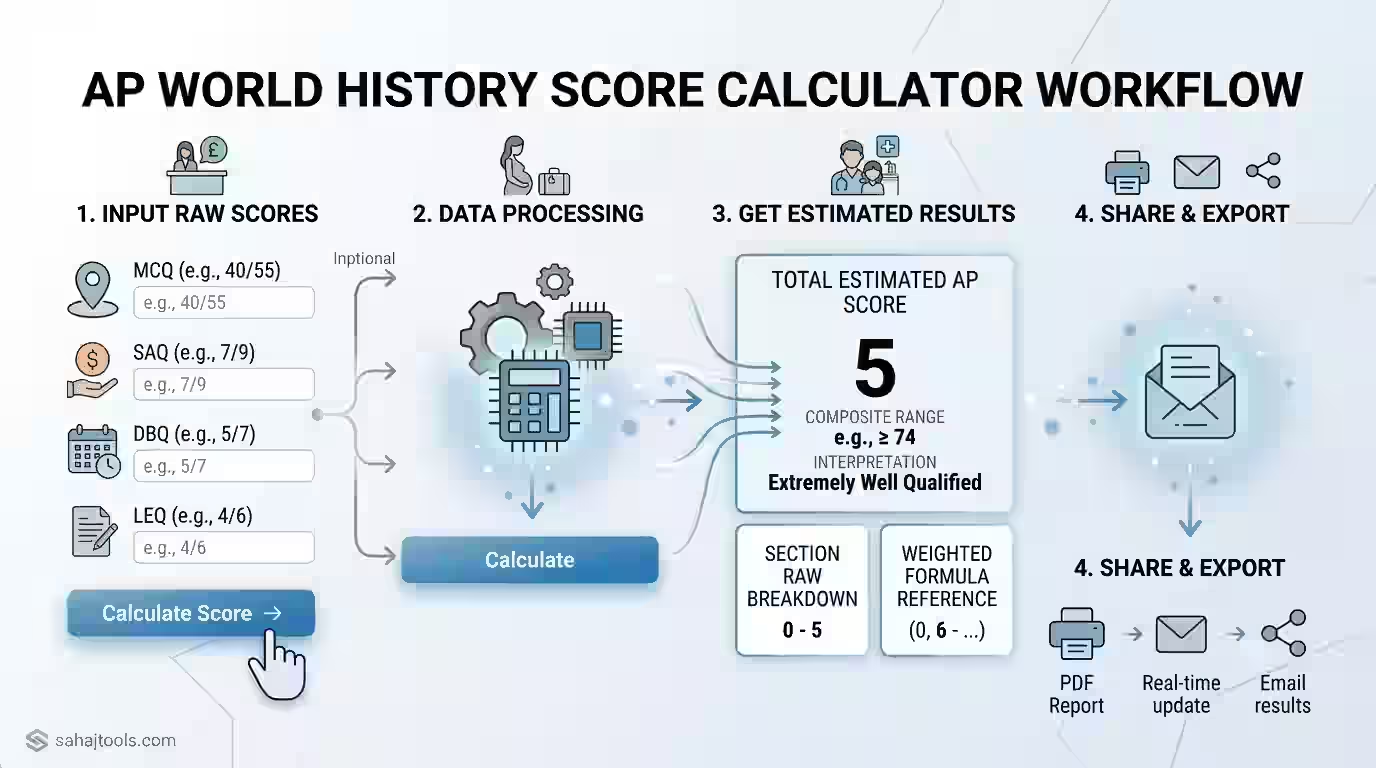
Wondering what your AP World History exam result will look like before scores post? The AP World Calculator converts your raw section points — Multiple Choice, Short Answer, DBQ, and LEQ — into an estimated 1–5 composite score using the same section weighting the College Board applies to the AP World History: Modern exam. Enter your points from each section, and the tool instantly maps your weighted total against historical AP score cutoffs, so you know roughly where you stand before the official release.
AP®
World History Score Calculator
Modern · Official College Board Weighting · 2025–26
ⓘEstimates are based on historical College Board curves. Actual cutoffs may vary ±3–4 composite points annually. Use as a study guide, not a guarantee.
Enter Your Raw Scores
MCQ40% of score
/ 55
Section I-A · 55 min · No penalty for guessing
SAQ20% of score
/ 9
Section I-B · 3 questions × 3 pts · 40 min
DBQ25% of score
/ 7
Section II-A · 7-pt rubric · 60 min (incl. 15 min reading)
LEQ15% of score
/ 6
Section II-B · 6-pt rubric · 40 min
Estimated AP Score
—
Composite
—
out of 100
1
2
3
4
5
Section Breakdown
MCQ
SAQ
DBQ
LEQ
Scoring Formula Reference
| Section | Raw Max | Weight | Weighted Formula |
|---|---|---|---|
| MCQ | 55 | 40% | (correct ÷ 55) × 40 |
| SAQ | 9 | 20% | (points ÷ 9) × 20 |
| DBQ | 7 | 25% | (points ÷ 7) × 25 |
| LEQ | 6 | 15% | (points ÷ 6) × 15 |
| AP Score | Composite Range (est.) | Interpretation |
|---|---|---|
| 5 | ≥ 74 | Extremely Well Qualified |
| 4 | 60 – 73 | Well Qualified |
| 3 | 46 – 59 | Qualified |
| 2 | 33 – 45 | Possibly Qualified |
| 1 | 0 – 32 | No Recommendation |
⚠ Cutoffs are estimates derived from historical College Board score distributions (2022–2024). The actual conversion table is not publicly released each year; actual cutoffs may shift ±3–4 points.
related education calculators
What the AP World History Score Calculator Does
This AP World History calculator takes your performance across all four exam sections and converts it into a projected AP score. It’s built for students who’ve just finished a practice test, a released free-response set, or the actual exam and want a realistic read on where their raw points land — without waiting months for College Board to post results. It’s equally useful for AP World History teachers benchmarking a class practice round, or parents trying to understand what a student’s practice score actually means.
The AP World exam score predictor doesn’t require you to guess how much each section counts. It applies the official weighting automatically, so a strong MCQ score and a shaky DBQ combine into one accurate composite — not a rough guess.
How the AP World History Score Calculation Works
The AP World History: Modern exam has four scored sections, and each one carries a different share of your final composite score:
Section | Raw Score Max | Section Weight | Weighted Formula |
Multiple Choice Questions (MCQ) | 55 | 40% | (correct ÷ 55) × 40 |
Short Answer Questions (SAQ) | 9 | 20% | (points ÷ 9) × 20 |
Document-Based Question (DBQ) | 7 | 25% | (points ÷ 7) × 25 |
Long Essay Question (LEQ) | 6 | 15% | (points ÷ 6) × 15 |
Add the four weighted values together, and you get a composite score out of 100. That composite is what maps onto the 1–5 AP score scale.
This is the same MCQ, SAQ, DBQ, and LEQ weighting structure the College Board uses to build the AP World History exam score, and it’s the foundation every AP World composite score calculator should be built on.
Worked Example: Turning a Raw Score Into an AP Score
Say a student answers 40 of 55 MCQs correctly, earns 6 of 9 SAQ points, scores 5 of 7 on the DBQ, and picks up 4 of 6 on the LEQ. Here’s how that raw score to AP score conversion plays out:
- MCQ: (40 ÷ 55) × 40 = 29.1
- SAQ: (6 ÷ 9) × 20 = 13.3
- DBQ: (5 ÷ 7) × 25 = 17.9
- LEQ: (4 ÷ 6) × 15 = 10.0
Adding those weighted values gives a composite score of about 70.3 out of 100 — which, based on recent AP World History score conversion patterns, lands solidly in the AP score of 4 range.
Current AP World History Score Cutoffs (Estimated)
These composite ranges reflect the pattern of recent College Board score distributions for AP World History: Modern. They’re the same reference points this AP World score predictor uses internally to translate a composite into a final AP score.
AP Score | Estimated Composite Range | What It Means |
5 | ≥ 74 | Extremely well qualified |
4 | 60–73 | Well qualified |
3 | 46–59 | Qualified |
2 | 33–45 | Possibly qualified |
1 | 0–32 | No recommendation |
These cutoffs are estimates, not official figures. The College Board does not publish its exact AP World History conversion table each year, and actual cutoffs typically shift by three to four composite points from one administration to the next based on that year’s exam difficulty. Treat this AP World exam score calculator as a study-planning guide, not a guarantee of your official score.
What Your AP World History Score Actually Means
A 3, 4, or 5 on AP World History: Modern isn’t just a number — it determines whether you’re eligible for college credit or course placement, depending on the policy at the school you plan to attend:
- Score of 5: Extremely well qualified. Most colleges that grant AP credit will award it here without hesitation.
- Score of 4: Well qualified. Widely accepted for credit or placement, though some selective schools set the bar at a 5 for this particular exam.
- Score of 3: Qualified. Many colleges award credit at this level, but policies vary more here than at the top of the scale.
- Score of 1–2: Below the threshold most institutions use for credit, though the exam itself still reflects real effort and exam experience.
Because credit policies differ by institution, always check your target college’s AP credit policy directly rather than relying on the general score interpretation above.
Common Mistakes When Estimating Your AP World Score
A few patterns throw off students using any AP World History grade calculator:
- Ignoring section weight differences. MCQ carries the most weight at 40%, so a weak multiple-choice section drags the composite down more than a single rough SAQ.
- Assuming DBQ and LEQ are scored the same way. The DBQ rubric runs to 7 points and counts for 25%; the LEQ tops out at 6 points and counts for 15% — treating them as interchangeable skews the estimate.
- Comparing this year’s practice curve to last year’s official cutoffs. Curves shift with exam difficulty, so a practice-test composite that hit a 4 last year might land differently this cycle.
Frequently Asked Questions
Your AP World History score is calculated by converting your raw points from each of the four sections — MCQ, SAQ, DBQ, and LEQ — into a weighted composite score, then mapping that composite onto the 1–5 AP score scale using the College Board's conversion table for that exam year.
The exam includes 55 MCQ points, 9 SAQ points, 7 DBQ points, and 6 LEQ points. Each section is weighted differently rather than added together directly — MCQ counts for 40% of the final score, SAQ for 20%, DBQ for 25%, and LEQ for 15%.
Multiple Choice Questions make up 40% of the composite score, Short Answer Questions make up 20%, the Document-Based Question makes up 25%, and the Long Essay Question makes up 15%.
Each section contributes a weighted share of your composite score based on how many raw points you earn out of that section's maximum, multiplied by its assigned weight. Because the weights differ, the same raw-point improvement affects your composite more in a heavily weighted section like MCQ than in a lightly weighted one like LEQ.
Based on recent College Board score distributions, a composite of roughly 46–59 typically corresponds to a 3, 60–73 to a 4, and 74 or higher to a 5. These are estimated ranges that can shift by a few points each year depending on exam difficulty.
The conversion takes your weighted composite score — calculated from all four sections combined — and matches it against a scaled-score table the College Board sets after each exam administration, based on that year's overall performance data.
A composite in the 60s or higher on a full-length practice test generally suggests you're tracking toward a 4 or 5 on exam day, though practice test curves don't always mirror the official exam curve exactly.
Enter your raw points from the MCQ, SAQ, DBQ, and LEQ sections into an AP World History score calculator that applies the correct 40/20/25/15 weighting, then compare the resulting composite score against the estimated cutoff table for a projected 1–5 AP score.
This AP World History score calculator is built for study planning, not as a substitute for official results. The College Board is the only authoritative source for your actual AP World History score, and its released curve for each exam year is the final word on where any composite score lands. Once official scores post, check them directly through your College Board account.
Last Update: July 2026