
Table of Contents
ToggleCorn Yield Calculator: Estimate Bushels Per Acre Before Harvest
🌽 Field Estimation Tool
Corn Yield Calculator Industry-standard Yield Component Method (University of Illinois) with
moisture correction and dual-unit output — bu/acre & kg/ha
USDA-StandardTwo Calculation ModesMoisture CorrectedField-Validated
Yield Component Method — Use from milk stage (R3) onward. Count harvestable ears in 1/1000th acre, then sample kernel rows and kernels per row from every 5th ear. Works before black layer.
Ear Weight Method — Use only after black layer / physiological maturity (30–35% grain moisture). Based on actual ear weight for higher accuracy. Counts and weighs every 5th ear.
🌽
Yield Estimate
Yield Component Method
± 20 bu/ac typical variance
Bushels per Acre—bu/acre@ 15.5% moisture
Kilograms per Hectare—kg/ha@ 15.5% moisture
Total Field Production—bushels
Yield Range (kernel weight variance)— to —
LowEstimatedHigh
View Calculation Breakdown
⚠️
Reset Calculator?
This will clear all inputs, results, and saved session data. This action cannot be undone.
A corn yield calculator estimates bushels per acre (or kg/ha) before harvest using the Yield Component Method — a University of Illinois field-sampling technique that combines harvestable ear counts, kernel rows, kernels per row, and a kernel weight factor. Growers use it from the milk stage (R3) onward to forecast yield for marketing, insurance, and harvest-logistics decisions well before a combine ever enters the field.
Try it now: plug in your row spacing, harvestable ear count, and kernel sampling data above to get an instant bu/acre and kg/ha estimate.
related agriculture & farming calculators
How to Use This Corn Yield Calculator
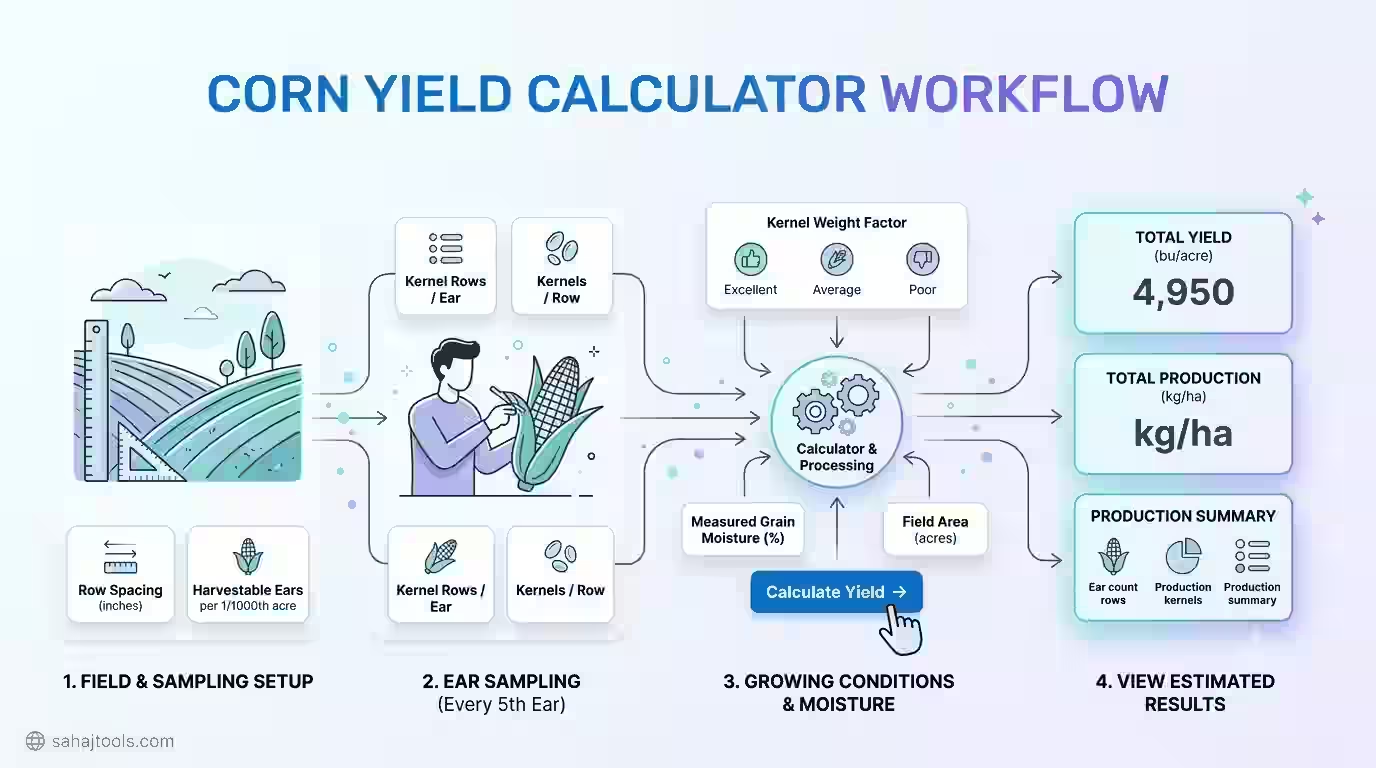
This corn yield estimator follows the same sequence agronomists use for in-season scouting:
- Enter row spacing in inches (20, 30, and 36 inches are typical US row widths).
- Count harvestable ears in a 1/1000th-acre section of row — the exact row length depends on your row spacing — and average this count across 3–5 sites across the field.
- Sample every 5th ear from that count and record kernel rows per ear (even numbers only, typically 12–18) and kernels per row, excluding very small tip kernels.
- Select a kernel weight factor. 90,000 represents average conditions; 80,000 assumes excellent, heavy kernels; 100,000 assumes poor or light kernel fill from stress.
- Enter measured grain moisture if you have it, so the calculator can adjust to the industry-standard 15.5% moisture basis.
- Add field area (optional) to convert your per-acre estimate into total field production.
The calculator returns bushels per acre, with kg/ha and total production shown alongside it.
The Corn Yield Formula: 1/1000-Acre Method Explained
This corn yield formula — often called the 1/1000-acre corn yield sampling method — was developed and popularized through University of Illinois and University of Wisconsin agronomy extension work, and it remains the standard field technique for grain corn yield prediction between the milk stage and black layer.
The core bushels-per-acre calculation is:
Yield (bu/acre) = (Ears per acre × Kernels per ear) ÷ Kernel weight factor
Breaking that down into the calculator’s inputs:
- Ears per acre comes from your harvestable ear count in 1/1000th of an acre, multiplied by 1,000.
- Kernels per ear is rows per ear (an ears-per-plant agronomic parameter) multiplied by kernels per row.
- Kernel weight factor is a stand-in for actual grain weight — essentially an inverse of the 1,000-kernel weight — because you can’t know final kernel weight until the crop reaches physiological maturity and black layer. The 80,000/90,000/100,000 range approximates a light-to-heavy kernel spread.
Because kernel weight factor is an assumption rather than a measurement until black layer, this method is best treated as a planning-grade estimate, not a guaranteed bushel count.
Converting to kg/ha and Tons/ha
For readers working in metric units, the same bushels-per-acre output converts directly: 1 bushel of corn per acre is approximately 62.77 kg/ha (based on the standard 56-lb US bushel and one acre equaling roughly 0.4047 hectares). A 200 bu/acre yield is therefore roughly 12,550 kg/ha, or about 12.5 metric tons/ha. This corn yield formula (1/1000 acre method) works identically in both unit systems — only the final conversion step changes.
Worked Examples: Two Corn Yield Scenarios
Example 1 — Average field conditions. Row spacing 30 inches, 32 harvestable ears per 1/1000-acre, 16 kernel rows, 34 kernels per row, kernel weight factor 90,000 (average conditions), grain moisture at 20%. Ears per acre: 32,000. Kernels per ear: 544. Raw yield: (32,000 × 544) ÷ 90,000 ≈ 193.4 bu/acre before moisture adjustment — landing in a typical “average yield scenario” range for well-managed Midwest fields.
Example 2 — Stressed field, poor kernel fill. Same row spacing and 28 harvestable ears, but drought stress during grain fill has reduced kernel rows to 14 and kernels per row to 28, with a kernel weight factor of 100,000 (poor/light kernels) reflecting light test weight. Ears per acre: 28,000. Kernels per ear: 392. Raw yield: (28,000 × 392) ÷ 100,000 ≈ 109.8 bu/acre — illustrating how quickly a low-yield scenario emerges when kernel set and kernel weight both decline together.
Running both a low and high assumption side by side (i.e., 80,000 vs. 100,000 kernel weight factor on the same ear and kernel counts) is the fastest way to bracket a realistic high/average/low corn yield range for a single field.
Correcting for Grain Moisture
Corn is bought, sold, and typically yield-reported at 15.5% moisture in the US. If your measured grain moisture is higher — common for early-season estimates — the calculator applies a moisture correction so the bushel figure reflects standard, comparable terms rather than “wet” field-condition bushels. Skipping this adjustment is one of the most common reasons a corn yield estimator overstates marketable yield, since wetter grain weighs more but shrinks after drying.
What Your Corn Yield Results Mean
The bu/acre (or kg/ha) figure is a per-acre productivity estimate, not automatically your total corn production. Multiplying that per-acre number by your entered field area gives total bushels or tons for the field — the number that matters for grain marketing contracts, storage planning, and trucking logistics. For harvest planning using a yield calculator, run the estimate at two or three points between milk stage and black layer; ear count and kernel rows stabilize early, but the kernel weight factor assumption should tighten as the crop approaches maturity. Growers doing profitability analysis based on corn yield typically pair this output with a break-even or farm profit tool once a marketing-grade estimate is in hand.
other agriculture calculators
- Crop Yield Calculator – Estimate harvest output for chicken feed crops like corn or soybeans.
- Fertilizer Application Rate Calculator – Optimize soil nutrients for pasture health.
- Irrigation Water Need Calculator – Ensure your flock’s water supply is sufficient, especially in free-range systems.
- Nitrogen Application Calculator – Balance nitrogen levels in poultry manure for garden use.
Factors That Affect Your Corn Yield Estimate
- Planting density and stand count. Final plant population directly drives ears per acre; thin or uneven stands lower the ceiling regardless of kernel quality.
- Soil type. Water-holding capacity and fertility variation across a field can shift kernel rows and kernels per row from one sampling site to the next — sample multiple sites, not just one.
- Irrigation method. Timely water during grain fill supports kernel weight; dryland fields under stress tend to land on the higher kernel weight factor (poorer, lighter kernels).
- Fertilizer application and yield response. Nitrogen timing and rate influence both ear size and kernel fill, particularly during the grain-fill window.
- Sampling error. Because this is a stand count yield estimation method, sampling only one or two sites — rather than the recommended 3–5 — inflates variability in the final bu/acre number.
World and regional average corn yields vary widely by management system and season, so treat any single benchmark figure as context, not a target this calculator is expected to match.
Technology-Assisted Yield Estimation
Drone-based corn yield analysis and crop monitoring platforms — tools like Agremo Crop Monitoring — increasingly supplement hand sampling by scanning stand count and canopy health across an entire field rather than a handful of sample sites. These tools don’t replace the underlying yield component formula; they feed better, field-wide ear-count and stand-count data into the same math this calculator uses.
Corn Grain Yield vs. Silage Yield
This is a grain corn yield calculator, not a silage corn yield calculator — the two use different math entirely. Grain yield counts kernels and estimates bushels; a silage yield estimate is based on whole-plant tonnage (tons per acre, wet basis) and doesn’t run through the kernel-row-and-count formula above. If you’re deciding between grain and silage harvest, run this grain estimate first, then compare it against a dedicated silage yield tool — the grain-to-silage yield relationship is heavily dependent on moisture and expected feed value, not just kernel count.
Comparison Table: Corn Yield Estimation Methods
Method | Best Used | Data Needed | Typical Accuracy Window |
Yield Component Method (this calculator) | Milk stage (R3) through black layer | Ear count, kernel rows, kernels/row, kernel weight factor | Planning-grade; tightens near maturity |
Stand-count-only estimate | Very early season (V6–V10) | Plants per acre only | Rough — ignores kernel fill entirely |
Seed-company yield apps (e.g., Pioneer-style calculators) | Season-long tracking | Similar field inputs, often app-based | Comparable, brand-specific assumptions |
Actual combine yield monitor | At harvest | Real-time weight/moisture data | Most accurate — ground truth |
Common Mistakes to Avoid
- Sampling only one location instead of 3–5 sites across the field.
- Forgetting the grain moisture correction and comparing “wet” bushels to standard 15.5% figures.
- Using the same kernel weight factor for every field regardless of visible stress — adjust it when kernel fill looks light.
- Confusing a grain yield estimate with a silage tonnage estimate.
- Treating one estimate as final instead of re-running the calculator as the crop advances toward black layer.
Expert Tip
Run the calculator twice at each sampling date — once with the 80,000 kernel weight factor and once with 100,000 — rather than committing to a single “average” number. That spread gives you a realistic high/average/low corn yield range you can actually market and plan storage around, instead of a single figure that reads as more precise than a pre-harvest estimate can honestly be.
Regional & Seasonal Considerations
This corn yield calculator uses US customary units (inches, acres, bushels) and the 15.5% US standard moisture basis. Readers outside the US working with a maize yield calculator in metric terms should rely on the kg/ha and tons/ha conversion above rather than assuming bushel figures translate directly. Timing also matters: the Yield Component Method is only valid from the milk stage (R3) onward — using it earlier, before ear and kernel counts have set, will understate the field’s actual potential.
Accuracy, Limitations & When to Get a Professional Opinion
This tool produces a planning-grade estimate, not a guaranteed yield figure — actual results depend on weather through the remainder of grain fill, disease pressure, and harvest conditions that can’t be captured in a single field sample. For decisions with real financial weight — grain marketing contracts, insurance elections, or storage capacity commitments — confirm your estimate with a local agronomist or your extension service before finalizing plans.
FAQ: Corn Yield Questions Answered
"Good" varies by region, hybrid, and management, so there's no single universal number — use your own multi-site average from this calculator, tracked across seasons on your specific ground, as your most reliable benchmark.
Sample 3–5 sites across the field for ear counts, then sample every 5th ear within those counts for kernel rows and kernels per row — a single sample site is the most common source of an inaccurate estimate.
It's a field-sampling technique that counts harvestable ears within a measured 1/1000th of an acre, then extrapolates that count — combined with kernel row and kernel count sampling — to a full per-acre yield estimate.
Smaller or lighter kernels (from stress during grain fill) mean more kernels are needed to reach a bushel's worth of grain weight, so a higher kernel weight factor (closer to 100,000) should be used; larger, heavier kernels use a lower factor (closer to 80,000).
Row spacing, harvestable ears per 1/1000-acre, kernel rows per ear, kernels per row, a kernel weight factor, and ideally measured grain moisture.
Stand count alone (plants per acre) only tells you potential ear-bearing capacity early in the season; it needs to be combined with kernel row and kernel count data later in grain fill to produce a real yield forecast.
Run the same ear and kernel counts through the calculator using a kernel weight factor of 80,000 (high/heavy-kernel scenario), 90,000 (average), and 100,000 (low/light-kernel scenario) to bracket a realistic range for your field.
Small fields amplify the effect of any single unrepresentative sample site, so smaller or more variable fields need proportionally more sampling sites to keep the estimate reliable.
Last Update: July 2026