
Table of Contents
ToggleSnowboard Size Calculator: Find Your Perfect Board Size
Getting the right snowboard size is the single biggest factor in how fun, controllable, and safe your riding feels. Our snowboard size calculator uses your height, weight, boot size, skill level, and riding style to recommend a board length, width, and flex rating in seconds — no guesswork, no generic size chart, just a number built around you.
If you want the number now, scroll to the calculator above. If you want to understand why it recommends what it does, keep reading — that context will help you sanity-check the result against any board you’re actually considering.
Expert Sizing Engine
Snowboard Size Calculator
Precise board length, width, flex & style recommendations — powered by real riding data.
Rider Profile
Tell us about yourself to personalise your recommendation.
Affects board length and flex defaults. Women's boards suit lighter, lower-volume builds.
Body Measurements
Weight is the #1 factor. Height and boot size refine the recommendation.
cm
ft
in
kg
lbs
Women's riders: add ~1.5 sizes to your women's size to get the US Men's equivalent (e.g. Women's 8 ≈ Men's 6.5).
Riding Style & Terrain
Your primary riding terrain shapes length, flex and board shape recommendations.
Reset Calculator?
This will clear all your inputs and results. Are you sure?
Most riders should size a snowboard using their weight first, height second. As a starting point, stand the board up next to you — it should reach somewhere between your chin and your nose. A calculator refines that further using your exact weight, boot size, skill level, and riding style, typically landing within a 3–6 cm range rather than one fixed number.
Why Weight Matters More Than Height for Snowboard Sizing
It’s tempting to size a snowboard the way you’d size a pair of skis or a bike frame — off height alone. But snowboards don’t work that way. Rider weight is the primary driver of snowboard length, because a board’s flex and effective edge are engineered to support and load correctly under a specific weight range. Too light a rider on too long a board will struggle to bend it into a turn; too heavy a rider on too short a board will feel the tail wash out at speed.
Height still matters — it affects your center of gravity and how much leverage you have over the board — but it’s a secondary adjustment, not the primary input. This is why two riders of the same height but a 30-pound weight difference often end up on boards several centimeters apart.
A useful gut-check before you ever touch a chart: stand the board upright on its tail in front of you. For most all-mountain riders, the nose should land somewhere between your chin and the tip of your nose. Shorter for freestyle and park riding, taller for powder and freeride. That’s the chin-to-nose height rule, and it’s a fine sanity check — but it’s a rule of thumb, not a substitute for weight-based sizing.
Your boot size adds a third dimension: it determines whether you need a regular, mid-wide, or wide board to avoid your boots hanging off the edges.
Snowboard Size Chart by Weight and Height
Use this snowboard size chart as a quick reference. It shows the general board length range for an all-mountain, intermediate setup — the calculator refines this further with your riding style and skill level.
Rider Weight | Rider Height | Recommended Board Length |
90–110 lbs | 4’8″–5’2″ | 128–138 cm |
110–130 lbs | 5’0″–5’5″ | 138–146 cm |
130–150 lbs | 5’3″–5’8″ | 146–152 cm |
150–170 lbs | 5’6″–5’11” | 150–156 cm |
170–200 lbs | 5’9″–6’2″ | 154–160 cm |
200–230 lbs | 6’0″–6’4″ | 158–164 cm |
230+ lbs | 6’2″+ | 162 cm+ |
These ranges assume a beginner-to-intermediate all-mountain rider. Freestyle riders typically size 2–4 cm shorter than this chart; freeride and powder riders size 4–8 cm longer. We’ll break each of those down below.
Board Width, Waist Width, and the Toe-Drag/Heel-Drag Problem
Length gets most of the attention, but board width — specifically waist width, the narrowest point of the board underfoot — is just as important, and it’s the piece most beginners get wrong.
Your boot size determines the waist width you need. If the board is too narrow for your boots, your toes and heels will hang past the edges. That overhang causes toe drag and heel drag — the edge of your boot or binding catching the snow mid-turn, which throws you off balance and can cause a fall, especially at speed or on hardpack.
As a rough guide:
US Boot Size (Men’s) | Recommended Waist Width |
7–8 | 240–250 mm (narrow) |
8.5–10 | 250–255 mm (regular) |
10.5–11.5 | 255–260 mm (wide) |
12+ | 260mm+ (wide) |
Should you choose a wide snowboard?
Only if your boot size calls for it. Riders with boot sizes above roughly US 10.5–11 (men’s) usually need a “wide” version of a board to get proper waist width without adding unnecessary length. Sizing up in length to fix a width problem is a common mistake — it throws off your flex and turn radius without solving the actual clearance issue. If you’re a women’s rider translating from a women’s boot size, add approximately 1.5 sizes to get the equivalent US Men’s sizing a board’s spec sheet will reference.
How Riding Style and Terrain Change Your Ideal Size
Two riders with identical height, weight, and boot size can need noticeably different boards once you factor in how they ride. Riding style shifts both length and flex:
- Freestyle / Park: Shorter and softer. A shorter board is easier to spin, press, and maneuver on rails and jumps. Expect to size 2–4 cm shorter than the all-mountain chart, with a soft-to-medium flex for forgiveness on landings.
- All-Mountain: True to size, medium flex. This is the baseline the chart above reflects — a versatile setup for groomers, some park, and light powder days.
- Freeride / Carving: Longer and stiffer. Extra length and a stiffer flex add stability at speed and better edge hold on steep or firm terrain. Expect to size 2–4 cm longer than all-mountain.
- Powder: Longest and typically medium-stiff. More surface area and often a directional or tapered shape keeps the nose floating in deep snow. Expect to size 4–8 cm longer than all-mountain, sometimes more for dedicated powder boards.
If you’re not sure which category you fall into, all-mountain is the safest default — it’s the most forgiving across the widest range of conditions, which is exactly why most calculators (including this one) treat it as the baseline before adjusting.
Skill Level Changes the Recommendation Too
Skill level acts as a modifier on top of your weight-and-height baseline, not a separate sizing system:
- Beginners (0–2 seasons) generally do better on a board sized slightly shorter than the standard chart — often 2–3 cm under — because a shorter board is easier to turn, more forgiving of mistakes, and less likely to catch an edge while you’re still building balance.
- Intermediate riders (2–5 seasons) typically size to the standard chart.
- Advanced and expert riders (5+ seasons) often size at or slightly above the chart, since they have the technique to control a longer board’s extra stability and speed.
This is exactly why a size chart alone isn’t enough — the same 160 lb, 5’9″ rider might be recommended a 148 cm board as a beginner and a 154 cm board as an advanced freeride rider.
Snowboard Sizing for Men, Women, and Kids
Men’s and women’s boards aren’t just marketed differently — women’s boards are generally built with a more centered stance, softer flex, and narrower waist widths to match a typically lighter average rider weight and smaller average boot size. If you’re a women’s rider using a men’s size chart, use your weight and boot size as the primary inputs rather than assuming a direct height match, since the flex tuning differs by brand.
Kids’ and youth sizing works on the same weight-first principle, but the ranges are compressed and change quickly as kids grow. A children’s snowboard size chart typically starts around 90 cm for very young/light beginners and scales up through youth sizes in the 100–140 cm range. Because kids often gain a size or two per season, many parents intentionally size slightly ahead of the current chart recommendation rather than replacing the board every year — a reasonable trade-off as long as it doesn’t compromise control.
How to Use This Calculator
- Enter your profile: gender, skill level, and preferred measurement units.
- Enter your body measurements: height, weight, and boot size (US Men’s). Women’s riders should add ~1.5 sizes to their women’s boot size to get the US Men’s equivalent the calculator uses.
- Select your riding style: Park/Jib, Freestyle, All-Mountain, Freeride/Carving, or Powder — plus an optional stance preference.
- Get your recommendation: a specific board length in centimeters with a size range, confidence score, width type, flex rating, board category, camber profile, stance width, and binding angle suggestions.
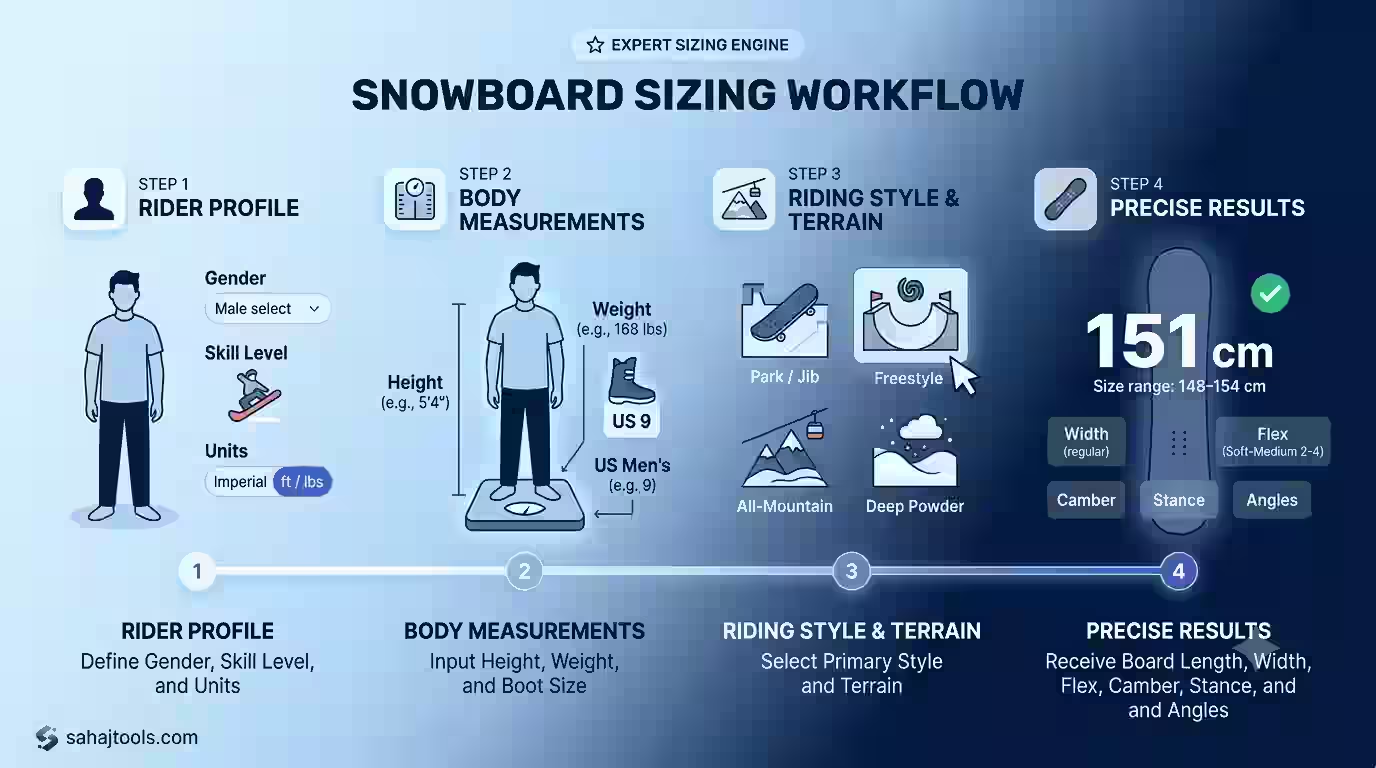
Worked example
A 5’10” (178 cm), 162 lb (73 kg) beginner rider with US 9 boots, riding freestyle, gets a recommended length of 151 cm (range 148–154 cm), regular waist width (252–258 mm), soft-medium flex (2–4), and a twin or near-twin freestyle shape. The calculator reaches that number by starting at 156 cm (about 88% of standing height, the all-mountain midpoint), then shifting −2 cm for the freestyle riding style and −3 cm for beginner skill level, while the boot size confirms a regular (not wide) waist width is appropriate.
Second scenario, for contrast
A 6’1″ (185 cm), 210 lb (95 kg) advanced rider with US 12 boots, riding freeride, would start from a taller baseline (~168 cm), add length for the heavier weight and freeride style, and land closer to 162–164 cm on a wide board — a meaningfully different result driven almost entirely by weight, boot size, and riding style rather than the 7 cm height difference alone.
A Word on Accuracy
A snowboard size calculator gives you a strong, data-informed starting point — not a guaranteed perfect fit. Flex patterns, core construction, and intended use vary by manufacturer, so always cross-check your recommendation against the specific board’s weight-range sticker or spec sheet before buying. If a recommendation sits right on the edge between two lengths, sizing down usually favors control and playfulness, while sizing up favors stability and float.
Frequently Asked Questions
Start with your weight, then refine with height, boot size, skill level, and riding style. As a rough check, the board should reach between your chin and nose when stood upright — but a calculator using your actual weight and boot size will be more precise than that rule alone.
Weight is the primary driver because it determines how much force you put through the board's flex. Height is a secondary adjustment that affects leverage and stance — two riders of the same height but different weights often need boards several centimeters apart.
Yes. Boot size determines the waist width you need to avoid your toes or heels hanging off the edge of the board. It doesn't directly change board length.
Slightly shorter than the standard all-mountain chart — typically 2–3 cm under — since a shorter board is easier to turn and more forgiving while you're still building balance.
Only if your boot size calls for it, generally above US 10.5–11 (men's). A wide board adds waist width without unnecessarily increasing length.
Freestyle and park riding call for shorter, softer boards for easy maneuvering. Freeride and carving call for longer, stiffer boards for stability at speed. Powder calls for the longest boards, for extra float in deep snow.
Typically 2–4 cm shorter than the standard all-mountain length for your weight and height, paired with a soft-to-medium flex.
Freeride: 2–4 cm longer than all-mountain, with a stiffer flex. Powder: 4–8 cm longer, often with a directional or tapered shape for float.
Match your board's waist width to your boot size rather than sizing by length alone. If your boots are size US 10.5 or above, look at wide or mid-wide board options.
It starts from a weight-based baseline length, adjusts for height, then applies modifiers for skill level and riding style, and finally checks boot size against waist-width requirements — combining all of it into a single length recommendation with a size range.
Last Update: August 2026