
Table of Contents
ToggleTattoo Cost Calculator: Estimate Your Tattoo Price Instantly
A tattoo cost calculator (also searched as a tattoo calculator cost tool) estimates what a tattoo will cost by combining the size of the design, its style and color complexity, body placement, and the artist’s hourly rate. This tattoo price estimator is built to answer the question everyone asks before booking a session at a tattoo studio.
Tattoo Cost
Calculator
Fill in your details below for a detailed, real-world price estimate — broken down by every factor that matters.
Estimated Cost
$0 – $0
Midpoint estimate: $0
⏱ Time Estimate
–
Estimated session hours
💵 Hourly Rate
–
Based on artist + region
📐 Area
–
Square inches
Cost Factor Breakdown
BudgetMid-rangePremiumLuxury
⚠️ Note: No universal formula exists for tattoo pricing — costs vary significantly by artist, studio, and location. These estimates are based on industry-accepted averages. Always consult your artist for a final quote.
Reset Calculator?
All inputs, results, and saved data will be cleared. This cannot be undone.
How much does a tattoo cost for what I have in mind, and how much are tattoos running right now in my area? Most small, simple tattoos in the U.S. run $50–$250, mid-size detailed pieces $300–$800, and large custom or realism work $1,000+, since larger studios typically charge $100–$250 per hour once a project moves past their shop minimum base price.
related hobby & diy calculators
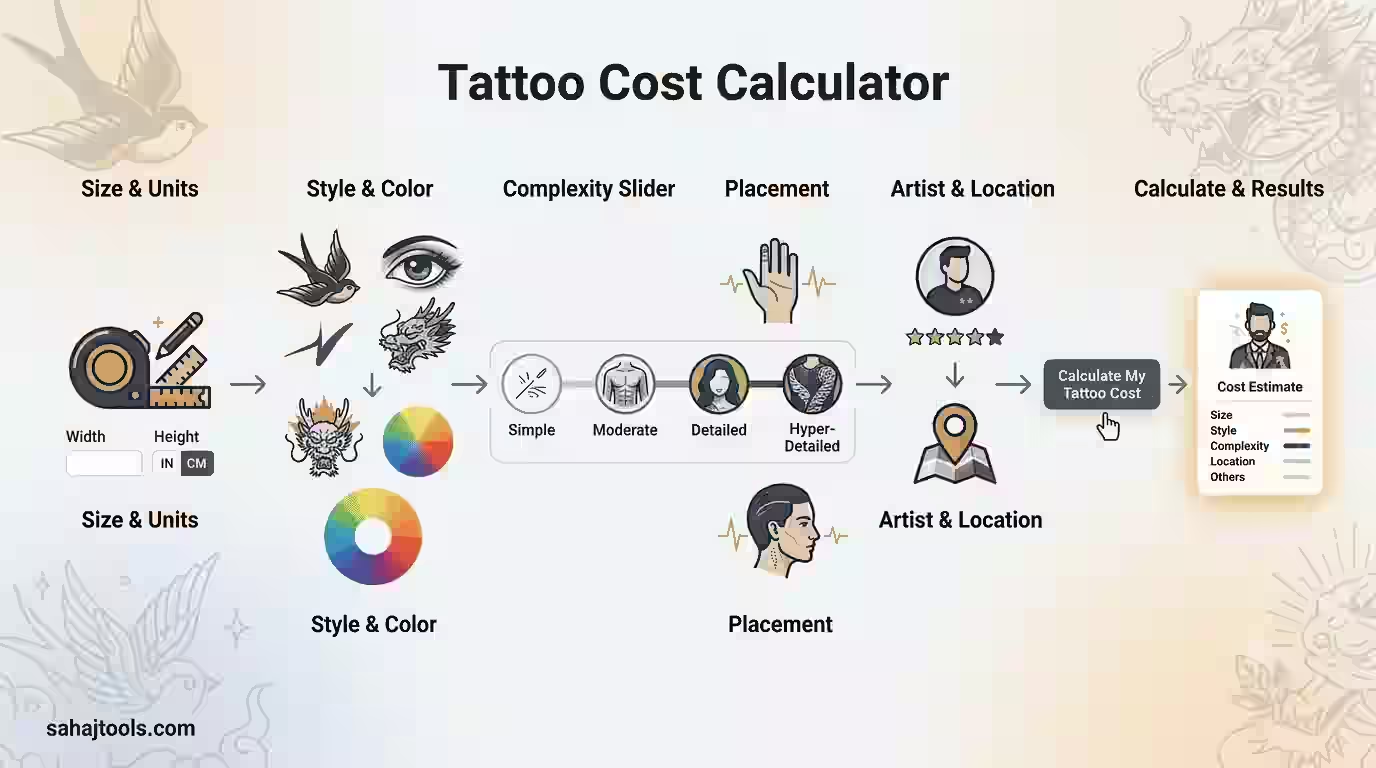
How to Use This Tattoo Price Calculator
- Enter your tattoo size — width and height of the tattooed area in inches or centimeters. This is what drives the tattoo cost per inch estimate.
- Choose a style and color palette — traditional, black & grey, realism, watercolor, geometric, Japanese, or a color range from black-and-grey-only to full color.
- Set complexity — simple, moderate, detailed, or hyper-detailed, based on how much fine linework, shading, or background the design needs. This is your tattoo complexity input.
- Pick your body placement — arm, back, leg, shoulder, ribs, hand, neck, or foot; tattoo placement has its own difficulty multiplier.
- Select artist experience and region — apprentice through celebrity-level artist, and your local market. Tattoo artist experience is one of the biggest swing factors in the final number.
- Check any additional options — cover-up, touch-up only, or a custom design fee.
- Hit calculate to get an estimated price range, not a single number, since real studios quote ranges too.
How the Tattoo Price Calculation Works
Tattoo pricing isn’t a single formula the way a lot of craft calculators are — it’s closer to a labor-cost estimate, because artists are almost always billing for time, not materials. Understanding the tattoo pricing factors behind the number helps you read your result correctly. The calculator combines four inputs into an estimated hour count, then multiplies that by an hourly tattoo rate:
Estimated Cost = (Base Hours × Complexity Multiplier × Placement Multiplier) × Artist Hourly Rate
- Base hours come from tattoo size — a rough industry rule of thumb is about 1 hour per 3×3 inches for moderate detail, though this shifts heavily with style, which is why tattoo cost by size alone never tells the full story.
- Complexity multiplier scales that time up: simple linework might take the baseline hours, while hyper-detailed realism tattoo cost or fine line tattoo pricing can run 1.5–3x longer than a bold traditional piece of the same physical size.
- Placement multiplier accounts for difficult areas — ribs, hands, and necks slow an artist down and often carry a 10–25% premium over flat, easy-to-reach areas like the forearm or upper arm.
- Tattoo session length matters too: longer sessions on large pieces sometimes carry a slightly lower blended hourly rate than several short bookings, since the artist avoids repeated setup and teardown.
Hourly rate is set by artist experience and region: apprentices might charge $50–$80/hour, mid-career artists $100–$150/hour, and sought-after or celebrity-level artists $200–$400+/hour.
Most shops also apply a shop minimum — commonly $50–$100 — regardless of how small the tattoo is, since setup, sterilization, and stencil time cost the same whether the tattoo takes 10 minutes or an hour.
A quick note on estimates: every number this calculator returns is a starting-point range, not a quote. Only the artist who examines your skin, design, and placement in person can give you an accurate price — and many studios require a tattoo consultation, often with a non-refundable tattoo deposit, before quoting anything final.
Worked Example
Say you want a 4×5 inch black-and-grey realism tattoo on your forearm, done by a mid-career artist charging $150/hour in a mid-sized U.S. city — a fairly typical scenario for custom tattoo pricing.
- Size: 4×5 inches ≈ 20 sq. in. → roughly 2.2 base hours at the moderate-detail baseline
- Style/complexity: realism is “detailed,” so apply a 1.8x multiplier → 4 hours
- Placement: forearm is an easy-access area, so no premium is added
- Rate: 4 hours × $150/hour = $600
Add a $75 consultation/design fee if custom artwork is involved, and you land around $600–$675 total — consistent with what black and gray tattoo cost typically looks like for realism forearm pieces of this size in most U.S. markets, and noticeably less than an equivalent color tattoo cost would run.
Understanding Your Results
The number you get back is a planning range, built to help you budget and have an informed conversation with an artist — not a binding price. A few things shift the real quote up or down from what the calculator shows:
- Deposits: most artists require a tattoo deposit (often $50–$200) to hold your appointment, which is usually credited toward the final price.
- Consultations: complex custom work almost always needs an in-person or video consultation first, where the artist gives you their own firm quote.
- Multiple sessions: large or heavily detailed pieces (full sleeves, back pieces) are rarely done in one sitting — expect the total cost to be the sum of several session bills, not one lump payment.
- Tipping: as with most personal-service industries in the U.S., tipping your tattoo artist 15–20% of the total cost is standard etiquette, especially for repeat work with the same artist. Some people use a general tattoo tip calculator approach — 15% for good service, 20%+ for exceptional work.
- Aftercare: budget for tattoo aftercare cost on top of the tattoo itself; it’s small, but it’s real.
If your estimate feels low for what you’re picturing, it’s usually the complexity or placement inputs — hyper-detailed work and difficult placements are the two biggest cost drivers, more than raw size alone. And remember that the average tattoo price you see quoted online is a national blend; your local tattoo studio’s actual session time and rates may run higher or lower depending on city and artist demand.
Tattoo Cost by Size, Style, and Placement
This tattoo price chart shows how average tattoo cost — and the average cost of tattoo work more broadly — shifts across the three biggest variables, based on typical tattoo cost in the United States.
Average Cost by Size
Tattoo Size | Approx. Size | Typical Cost Range (USA) |
Small (e.g., small symbol, text) | Up to 2×2 in | $50–$150 |
Medium | 3×3 to 5×5 in | $150–$450 |
Large | 6×8 to 10×10 in | $450–$1,200 |
Extra Large / Half Sleeve | Larger than 10×10 in | $1,200–$3,000+ |
Full Sleeve | Full arm | $3,000–$8,000+ (multi-session) — this is where sleeve tattoo cost climbs fastest |
Average Cost by Style
Style | Relative Cost Driver | Why |
Traditional | Lower | Bold lines, solid fills — faster to execute |
Black & Grey | Low–Moderate | No color mixing, but shading adds time |
Flash design | Low–Moderate | Flash tattoo pricing is usually lower since the design is pre-made, not custom |
Geometric | Moderate | Precision line work slows pacing |
Watercolor | Moderate–High | Color blending and layering take longer |
Japanese / Irezumi | High | Large-scale, multi-session by nature |
Realism | Highest | Fine detail and shading are the most time-intensive style |
Average Cost by Body Placement
Placement | Cost Impact |
Arm / Forearm | Baseline — easiest to access |
Shoulder | Baseline to slight premium |
Leg / Thigh | Baseline |
Back / Chest | Slight premium — larger canvas, more planning |
Ribs / Side | 10–20% premium — painful, slower sessions |
Hand / Finger | 15–25% premium — high skill, high fade risk |
Neck / Face | 15–25% premium — precision and visibility risk |
Foot / Ankle | Slight premium — bone proximity slows pacing |
Common Mistakes & Pro Tips
- Comparing quotes by price alone. Chasing affordable tattoo artists on price alone isn’t the best deal if it means a less experienced artist on a design you’ll wear forever — portfolio quality matters more than price per hour.
- Forgetting the shop minimum. A tiny tattoo doesn’t mean a tiny bill; almost every studio has a flat minimum charge regardless of size.
- Underestimating cover-up cost. Covering existing ink typically adds 25–40% to the price, since the artist has to design around and often darken the old tattoo first.
- Skipping the consultation. Custom, detailed, or large-scale work almost never gets an accurate quote without the artist seeing your skin and reference images in person.
- Not budgeting for aftercare. Aftercare products (fragrance-free lotion, specialty balm, sometimes protective film) typically add $15–$40 on top of the tattoo itself — small, but worth planning for.
- Forgetting the tip. Build in 15–20% for gratuity when comparing your final out-the-door cost, the same way you would for any personal-service appointment.
other Related Calculators You Might Need
- 3D Print Material Cost Calculator: Planning to 3D print custom parts for your vehicle? Use this tool to estimate filament costs based on material type (PLA, ABS, PETG), part size, and infill percentage.
- Resin Print Cost Calculator: For high-detail resin prints (e.g., custom emblems, interior trim), this calculator helps you compare resin costs and print time for SLA/DLP printers.
frequently asked questions (FAQ)
Most tattoos in the U.S. range from $50 for a small, simple design up to $1,000+ for large, detailed, or full-color pieces. The biggest factors are size, complexity, placement, and the artist's hourly rate.
Forearm tattoos are usually on the more affordable end of the placement scale since the area is easy for the artist to access. A small-to-medium forearm piece typically runs $150–$450, depending on style and detail level.
Hourly rates generally range from $50–$80 for apprentices, $100–$150 for experienced mid-career artists, and $200–$400+ for highly sought-after or celebrity-level artists, varying by region and studio reputation.
A small tattoo (under 2×2 inches) typically costs $50–$150, often at the shop's flat minimum. A full sleeve, by contrast, usually requires multiple sessions and can run $3,000–$8,000+ in total.
Cover-ups typically cost 25–40% more than a comparable new tattoo in the same spot, because the artist must design around the existing ink and often needs extra passes of darker saturation to fully conceal it.
Generally yes — full-color work takes longer due to color mixing, layering, and touch-up passes, so it often costs 10–30% more than an equivalent black-and-grey design of the same size and complexity.
The standard is 15–20% of the total cost, similar to other personal-service industries. For larger multi-session pieces, tipping at the end of each session is common practice.
Last Update: July 2026