
Table of Contents
ToggleLens Thickness Calculator: Estimate Center & Edge Thickness by Prescription
Wondering how thick your new glasses lenses will actually be before you order them? A lens thickness calculator estimates both center and edge thickness using your prescription, lens diameter, base curve, and refractive index — so you can compare materials and avoid bulky, unflattering lenses.
Lens Thickness Calculator
Optically accurate · Real-time · Professional grade
01 Prescription
–30.00 to +30.00 D
–10.00 to +10.00 D (optional)
0° to 180° (optional)
02 Lens Parameters
40 – 80 mm
0 – 15.00 D
Select lens material
1.400 – 2.000
Leave blank for auto-estimate
Results
—
—
Edge Thickness
mm
—
Center Thickness
mm
Front Sag (s₁)—
Back Sag (s₂)—
Back Curve—
Semidiameter—
Refractive Index—
Eff. Power (max)—
Relative Thickness Profile
Reset Calculator?
All inputs and results will be cleared. This cannot be undone.
Calculations based on the Sag formula and Lensmaker's equation per ISO 10110 optical standards. Results are indicative; consult a qualified optician for clinical decisions.
Lens thickness is calculated from your sphere and cylinder power, the lens diameter, and the refractive index of the material. Higher prescriptions and lower-index materials produce thicker lenses; high-index materials (1.67, 1.74) and smaller frames reduce both center and edge thickness significantly.
related health & fitness calculators
What Is a Lens Thickness Calculator
A lens thickness calculator is a tool that predicts the center and edge thickness of a spectacle lens before it’s cut and edged in the lab. It combines your prescription (sphere, cylinder, and axis), the chosen lens diameter, the base curve, and the refractive index of the lens material to model the lens’s optical profile.
Opticians, optical lab technicians, and optometrists use this kind of eyeglass lens thickness calculator to plan lab orders and set patient expectations. Consumers with stronger prescriptions also use it as a spectacle lens thickness estimator to compare high-index options before buying, particularly to avoid the bulky “coke bottle” look associated with older, low-index glass or standard plastic lenses.
How the Lens Thickness Calculator Works — The Formula
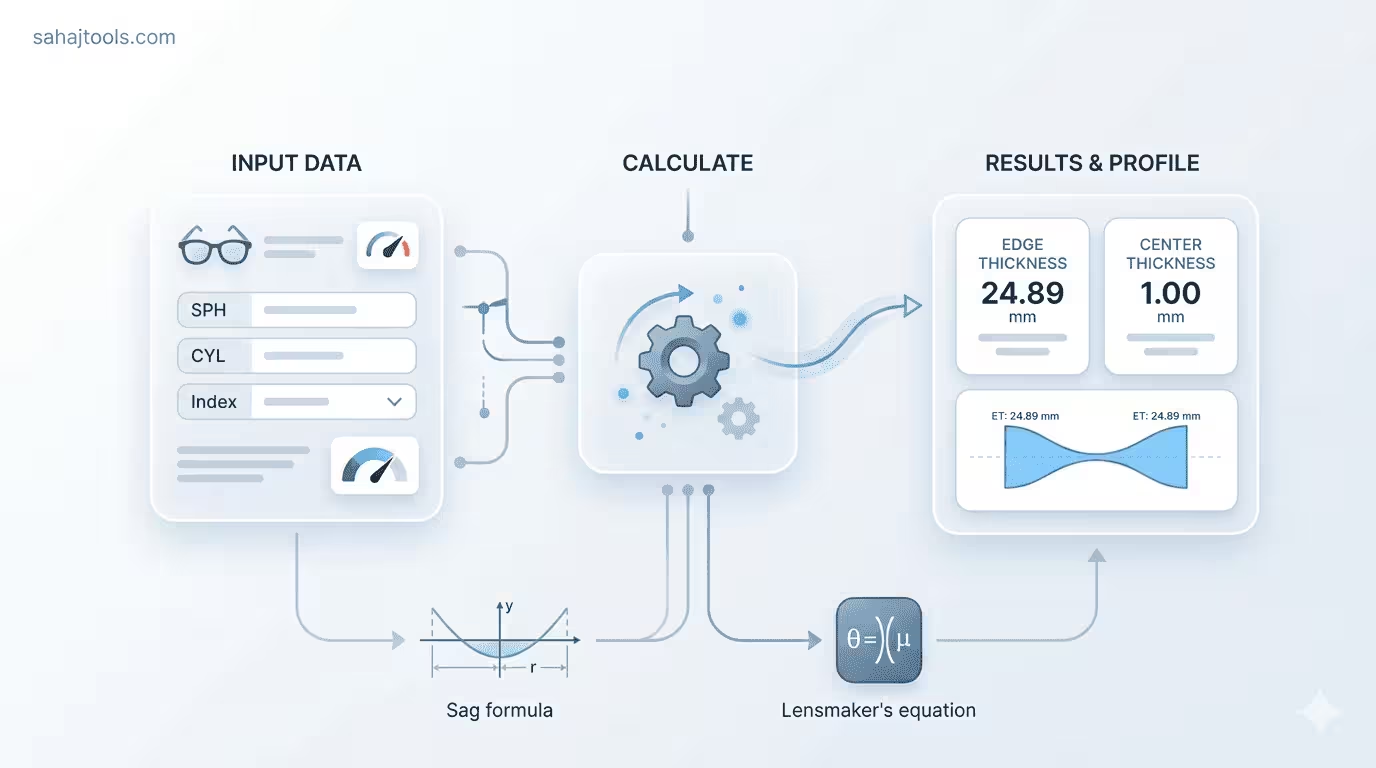
Lens thickness is derived from the sag formula (sagittal depth), combined with the lensmaker’s equation, which together model how much a curved lens surface rises or falls across its diameter.
Sag Formula:
s = r − √(r² − y²)
Where:
- s = sagittal depth (how much the surface curves away from flat)
- r = radius of curvature of the lens surface (derived from base curve)
- y = half the lens diameter (semi-diameter)
Center thickness (for plus/convex lenses) is approximately:
Center Thickness = Edge Thickness + (Front Sag − Back Sag)
Edge thickness (for minus/concave lenses) is approximately:
Edge Thickness = Center Thickness + (Back Sag − Front Sag)
The radius of curvature itself comes from the base curve power using the lensmaker’s relationship:
r = (n − 1) / D
Where n is the refractive index of the lens material and D is the surface power in diopters.
Worked example (USA prescription): For a patient in the United States with a prescription of −5.00 D sphere, a 65 mm lens diameter, a 6.00 D base curve, and a 1.50 refractive index (standard CR-39 plastic), the calculator estimates a center thickness of roughly 2.2 mm and an edge thickness of approximately 8.5–9.0 mm — noticeably thick. Switching the same prescription to a 1.67 high-index material typically reduces edge thickness to around 6.0–6.5 mm, a meaningful cosmetic improvement.
Refractive Index | Material Type | Relative Thickness | Common Use Case |
1.50 | CR-39 (hard resin) | Thickest baseline | Low prescriptions (±2.00 D or less) |
1.56 | Standard plastic | Slightly thinner | Mild-to-moderate prescriptions |
1.60 | Mid-index (MR-8) | Moderately thinner | Moderate prescriptions (±2.00–4.00 D) |
1.67 | High-index (MR-7) | Significantly thinner | Strong prescriptions (±4.00–7.00 D) |
1.74 | Ultra-high-index (MR-174) | Thinnest available | Very strong prescriptions (7.00 D+) |
Step-by-Step Guide: How to Use the Lens Thickness Calculator
- Enter Sphere (SPH) — Input your prescription’s sphere power, from −30.00 to +30.00 D.
- Enter Cylinder (CYL) — Add cylinder power if you have astigmatism, from −10.00 to +10.00 D (optional).
- Enter Axis — Input the axis in degrees (0°–180°) if cylinder is used (optional).
- Set Lens Diameter — Choose your lens diameter in millimeters, typically 40–80 mm based on frame size.
- Set Base Curve (BC) — Enter the base curve in diopters (0–15.00 D); leave default if unsure.
- Select Refractive Index — Choose the lens material (1.50, 1.56, 1.60, 1.67, or 1.74) from the dropdown.
- Leave Center Thickness on Auto — Skip this field to let the calculator auto-estimate, or enter a known lab minimum.
- Click “Calculate Thickness” — Review your estimated center and edge thickness instantly.
Common input errors to avoid:
- Entering cylinder power without an axis, which skews edge thickness at 180° readings
- Selecting the wrong sign convention (mixing plus and minus cylinder forms)
- Choosing a lens diameter larger than your actual frame requires, which inflates edge thickness unnecessarily
- Forgetting that pupillary distance and lens decentration also affect real-world edge thickness beyond what the base calculation shows
Result Interpretation: What Your Numbers Mean
Result Range | Interpretation | Typical Action |
Center/Edge under 3 mm | Thin, low-visibility lens | No changes needed |
3–6 mm | Moderate thickness | Acceptable for most frames; consider 1.60 index for larger frames |
6–9 mm | Noticeably thick | Consider higher index (1.67) or smaller frame |
9 mm+ | Very thick, cosmetically bulky | Strongly consider 1.67–1.74 index and a smaller, rounder frame shape |
For minus (concave) lenses, the edge is thickest and the center is thinnest — this is the number to watch for high myopia. For plus (convex) lenses, the reverse is true: the center is thickest, which affects magnification and lens weight more than edge bulk.
Real-Life Examples
Scenario 1 — Optician fitting a strong myope: A U.S. optical shop is fitting a patient with a −7.50 D prescription into a 52 mm frame. Using the lens thickness calculator with a 1.67 index and 6.00 D base curve, the technician estimates an edge thickness of about 5.8 mm — thin enough for the patient’s chosen frame without special edge polishing.
Scenario 2 — Optometrist counseling a patient on lens index: A patient with +6.00 D hyperopia asks why their old CR-39 lenses look so thick at the center. Running the numbers through the calculator at 1.50 versus 1.74 index shows a drop from roughly 9.5 mm to 6.0 mm center thickness, giving the optometrist a clear visual talking point for recommending the upgrade.
Scenario 3 — Consumer comparing options before ordering online: A shopper with a −4.25 D / −1.00 D cylinder prescription uses the calculator as an online lens thickness simulator to compare a 65 mm versus 58 mm lens diameter in the same frame style, seeing edge thickness drop by nearly 2 mm simply by choosing the smaller effective lens diameter (ED).
Lens Thickness Calculator vs. Manual Lab Estimation
Feature | This Calculator | Manual Lab Estimation |
Speed | Instant, real-time result | Minutes per calculation |
Consistency | Same formula every time | Varies by technician experience |
Use Case | Pre-order comparison, patient education | Final lab cutting specifications |
Accuracy for Final Order | Estimate only | Precise, accounts for edging equipment |
Use the calculator for planning and patient conversations; rely on your optical lab’s final edging specifications for the actual cut lens.
Country-Specific Considerations (USA)
In the United States, spectacle lenses are typically manufactured to ANSI Z80.1 standards for prescription accuracy and impact resistance, and calculators like this one are designed to be broadly consistent with those tolerances, though individual lab equipment can introduce small variations. U.S. opticians commonly stock CR-39 (1.50), polycarbonate (1.59), and high-index (1.67/1.74) materials, with polycarbonate favored for safety and sports frames due to impact resistance rather than thinness alone.
Limitations & Accuracy
This lens thickness calculator provides an estimate, not a lab-certified measurement. It cannot fully account for:
- Lab-specific minimum edge thickness requirements for structural safety
- Frame groove depth and bevel placement, which affect visible edge thickness
- Pupillary distance and decentration beyond a simplified model
- Lens coatings (anti-reflective, blue light) that add negligible but nonzero thickness
The formula is based on standard optical sag formula and lensmaker’s equation principles consistent with ISO 10110 optical standards, but actual results depend on your optical lab’s specific manufacturing tolerances. Always confirm final measurements with your optician or lab before finalizing an order.
Benefits of Using This Lens Thickness Calculator
- Pre-purchase clarity — Compare refractive indices before committing to a lens material.
- Faster patient consultations — Opticians and optometrists can visually explain thickness trade-offs in seconds.
- Avoids costly reorders — Lab technicians can flag unusually thick estimates before cutting begins.
- Cosmetic planning — Helps consumers with high myopia or hyperopia choose frames and materials that minimize bulky “coke bottle” lens edges.
- Weight estimation — Thinner lens estimates also correlate with lighter finished glasses, improving comfort.
Common Mistakes When Estimating Lens Thickness
- Ignoring frame size impact — A larger lens diameter dramatically increases edge thickness for minus lenses; always match diameter to your actual frame.
- Skipping the base curve — Leaving base curve at an unrealistic default can distort both center and edge results.
- Confusing center and edge thickness — For strong minus prescriptions, edge thickness matters most; for strong plus prescriptions, center thickness matters most.
- Overlooking material choice — Many users stick with 1.50 CR-39 out of habit, missing the thickness reduction available from 1.60–1.74 high-index materials.
- Assuming the estimate is lab-final — Treating the calculator’s output as an exact manufacturing spec rather than a planning estimate.
Frequently Asked Questions (FAQs)
Enter your sphere and cylinder power, lens diameter, base curve, and refractive index into the calculator. It applies the sag formula to each lens surface and outputs estimated center and edge thickness in millimeters.
At a standard 1.50 index and 65 mm diameter, a −5.00 D lens typically shows an edge thickness around 8–9 mm, while a +5.00 D lens shows a similar center thickness. Choosing a 1.67 index can reduce either by roughly 30%.
Higher refractive index materials bend light more per unit of thickness, so the lens needs less physical material to achieve the same prescription power. Moving from 1.50 to 1.67, for example, commonly cuts edge or center thickness by a quarter to a third.
For prescriptions under ±2.00 D, standard 1.50 or 1.56 is usually fine. For ±2.00–4.00 D, 1.60 mid-index is a good balance. For ±4.00 D and above — including high myopia — 1.67 or 1.74 ultra-high-index materials give the thinnest, lightest result.
Smaller, rounder frames reduce the effective lens diameter, which directly reduces edge thickness on minus lenses. Larger or more angular frames increase the distance from the optical center to the frame edge, increasing thickness proportionally.
Minus (concave) lenses are thinnest at the center and thickest at the edge, so edge thickness is the key number. Plus (convex) lenses are thickest at the center and thinnest at the edge, so center thickness matters most for cosmetic and weight purposes.
Yes. An online lens thickness simulator like this one lets you test different refractive indices, diameters, and base curves against your exact prescription before committing to a lab order, helping you compare cosmetic and weight outcomes in advance.
They provide a close estimate based on standard optical formulas, but real lenses can vary slightly due to lab-specific minimum thickness rules, frame bevel placement, and edging equipment tolerances. Treat results as a planning guide rather than a final specification.
Lens weight scales with both thickness and material density. Thinner high-index lenses (1.67, 1.74) are generally lighter than thicker 1.50 CR-39 lenses of the same prescription, even though high-index materials are slightly denser per cubic centimeter.
Yes. When pupillary distance doesn't match the frame's geometric center, the lens must be decentered, which shifts the optical center and can increase edge thickness on one side more than the other — especially noticeable in stronger prescriptions.
Start with a blank size calculator to confirm the minimum lens blank needed for your frame and pupillary distance, then run that diameter through the lens thickness calculator to estimate the resulting center and edge thickness for your chosen material.
They're typically the same tool applied to different lens types: center thickness estimation matters most for plus-power lenses, while edge thickness estimation matters most for minus-power lenses. This calculator provides both simultaneously.
Reference Link
- American Optometric Association (AOA): Ophthalmic metrics and clinical guidance for vision corrections in the United States.
- International Organization for Standardization (ISO): Standard: ISO 10110 — Optics and Photonics — Preparation of Drawings for Optical Elements and Systems.
- American National Standards Institute (ANSI): Standard: ANSI Z80.1 — American National Standard for Ophthalmic — Prescription Ophthalmic Lenses.
- U.S. Food and Drug Administration (FDA): Regulation: 21 CFR Part 801 — Medical Device Labeling and Ophthalmic Lens Impact Compliance Rules.
Disclaimer: This lens thickness calculator is for informational and planning purposes only and does not replace a professional eyewear fitting. Actual lens thickness may vary based on your optical lab’s equipment and manufacturing tolerances. Always consult a qualified optician or optometrist before finalizing your lens order.
Last Update: July 2026