
Table of Contents
TogglePond Volume Calculator: Know Your Pond's Gallons Instantly
To find your pond’s volume, multiply length × width × average depth, then apply a conversion factor for your shape and unit. For a simple rectangular pond that’s 10 ft long, 8 ft wide, and 2 ft deep, the math is 10 × 8 × 2 = 160 cubic feet, which converts to roughly 1,197 gallons (or about 4,530 litres). Our Pond Volume Calculator does this instantly for rectangular, circular, oval, and irregular ponds, and switches between gallons, litres, and cubic metres with one click.
Whether you’re dosing a water feature, sizing a pump, or ordering a liner, getting this number right the first time saves you money and second-guessing later.
Pond Volume Calculator
Precise calculations for every pond shape — instantly converted to all major units.
4 Pond Shapes3 Unit SystemsPDF ExportAuto-Save
01
Select Pond Shape
Choose the shape that best matches your pond.
02
Enter Dimensions
Input your pond measurements in your preferred unit.
03
Volume Results
—Liters
Cubic Meters—m³
Cubic Feet—ft³
US Gallons—US gal
UK Gallons—UK gal
Cubic Yards—yd³
Cubic Inches—in³
🐟
Fish Stocking Estimate:—
How to Measure an Irregular Pond
Most backyard ponds aren’t perfect rectangles, and that’s fine — you don’t need a perfect shape to get a usable number. For an irregular or freeform pond, the trick is to work with average dimensions rather than exact ones:
- Length: measure the longest point from end to end.
- Width: measure the widest point, perpendicular to the length.
- Average depth: take 3–5 depth readings across the pond (shallow edges, deeper middle) and average them, rather than using the single deepest point.
This “average dimension” approach is the same method professional pond builders use for estimating excavation and liner needs, and it’s accurate enough for dosing, pump sizing, and stocking decisions. If your pond has a very irregular outline — a figure-eight or kidney shape, for example — you can also break it into two or three rough sections, calculate each separately, and add the results together.
The Pond Volume Formula (by Shape)
Every pond volume calculation starts from the same idea: surface area × average depth = volume. The formula just changes slightly depending on your pond’s shape.
Rectangular or square pond:
Volume = Length × Width × Average Depth
Example: 12 ft × 6 ft × 3 ft = 216 cubic feet → about 1,616 gallons
Circular or round pond:
Volume = π × Radius² × Average Depth
Example: an 8 ft diameter pond (radius 4 ft), 2.5 ft deep → π × 4² × 2.5 ≈ 125.7 cubic feet → about 940 gallons
Oval or elliptical pond:
Volume = π × (Long Axis ÷ 2) × (Short Axis ÷ 2) × Average Depth
Example: a 10 ft × 6 ft oval, 2 ft deep → π × 5 × 3 × 2 ≈ 94.2 cubic feet → about 705 gallons
Irregular or freeform pond:
Volume = Average Length × Average Width × Average Depth
(using the average measurements described above)
Once you have cubic feet or cubic metres, the conversion to liquid volume is simple: multiply cubic feet by 7.48 for US gallons, or cubic metres by 1,000 for litres. Our calculator applies these conversions automatically, so you never have to do the multiplication by hand.
How to Use the Pond Volume Calculator
The calculator is built around two quick steps, whether your pond is a simple rectangle or a freeform shape.
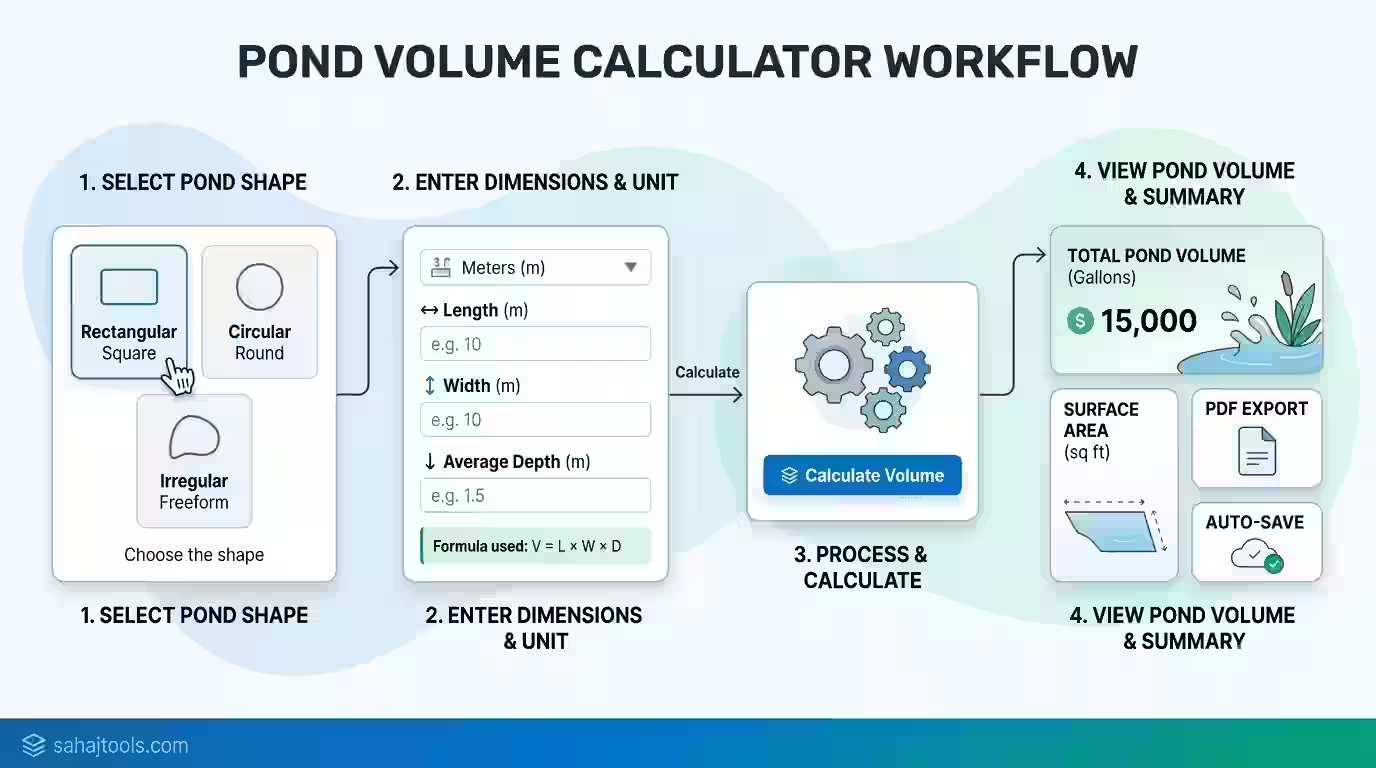
- Select your pond shape. Choose from four shape cards — Rectangular/Square, Circular/Round, Oval/Elliptical, or Irregular/Freeform. Each card shows a simple icon so you can match it to your pond at a glance.
- Pick your measurement unit. Use the unit dropdown to switch between metric (metres), imperial (feet), or the built-in US customary option — the tool supports three unit systems, so you can enter numbers however you originally measured.
- Enter your dimensions. Depending on the shape you selected, you’ll fill in fields such as Length (the longest horizontal dimension), Width (the shortest horizontal dimension), and Average Depth (the mean water depth). Each field shows a placeholder example so you know the expected format.
- Check the formula reference. Under the input fields, the tool displays the exact formula it’s using for your selected shape — for a rectangular pond, this is V = Length × Width × Depth — so you can see the math, not just trust a black box.
- Tap Calculate Volume. Your result appears instantly, converted automatically across gallons, litres, and cubic feet/metres, so you can read whichever unit you actually need.
The calculator also auto-saves your last entries and lets you export your results as a PDF — handy if you’re sharing measurements with a pond builder, liner supplier, or pump retailer.
Liner Size & Material Notes
Your pond volume number feeds directly into liner sizing, so it’s worth getting right before you buy. As a rough starting point, liner size is generally estimated as:
Liner Length = Pond Length + (2 × Depth) + 2 ft overlap
Liner Width = Pond Width + (2 × Depth) + 2 ft overlap
This accounts for the liner running up and over the pond walls with enough excess to anchor the edges. For excavated volume (how much soil you’ll actually remove), your pond volume figure is a close approximation, though you should add a small margin for uneven digging.
When it comes to material, look for fish-safe pond liners — EPDM rubber and reinforced PVC are the most common choices for backyard ponds, since both are rated as non-toxic to fish and plants once rinsed and cured. Avoid liners marketed only for construction or roofing use, as these aren’t tested for aquatic safety.
Stocking & Fish Safety Considerations
Once you know your pond’s volume, it becomes the baseline for almost every other decision — fish stocking capacity, filtration needs, pump sizing, and dosing amounts for water treatments.
- Pump sizing: as a general rule of thumb, aim to turn over your entire pond volume once every 1–2 hours for a healthy, filtered pond.
- Filtration needs: filter capacity should be rated for at least your total pond volume, and ideally slightly above it if you plan to add fish.
- Fish stocking capacity: a commonly used starting guideline is roughly 1 inch of adult fish per 10 gallons of water, though this varies significantly by species, filtration strength, and aeration.
A note on fish and livestock welfare: Stocking guidelines here are general starting points. Always check the care requirements of your specific fish or plant species before finalizing stocking levels.
Why Accurate Volume Matters
An inaccurate volume estimate doesn’t just throw off your math — it can lead to an undersized pump that leaves water stagnant, an over-ordered liner that wastes money, or a treatment dose that’s too weak (or too strong) for the actual water volume. Taking five extra minutes to measure carefully, and letting the calculator handle the conversions, pays off in fewer surprises later.
Common Measuring Mistakes
- Using maximum depth instead of average depth — this consistently overestimates volume, sometimes significantly.
- Skipping shelf areas — many ponds have shallow marginal shelves around the edge; ignoring these in your average depth reading skews the result.
- Mixing units mid-measurement — entering some numbers in feet and others in metres without converting first.
- Forgetting overlap when buying liner — using raw pond dimensions instead of the liner formula above leads to a liner that’s too small.
Frequently Asked Questions
Multiply length × width × average depth for a rectangular pond, or use the shape-specific formula for circular, oval, or irregular ponds. Our calculator handles the math and unit conversion for you automatically.
The base formula is Length × Width × Average Depth for rectangular ponds. Circular ponds use π × Radius² × Depth, and oval ponds use π × half the long axis × half the short axis × Depth.
Convert your volume in cubic feet to gallons by multiplying by 7.48. A 200-cubic-foot pond holds roughly 1,496 gallons — our calculator does this conversion instantly.
Multiply your volume in cubic metres by 1,000 to get litres. A 5-cubic-metre pond holds 5,000 litres.
Add twice your average depth plus about 2 feet of overlap to both the length and width of your pond. This gives enough material to line the walls and anchor the edges securely.
As a general guideline, size your pump to turn over your entire pond volume once every 1–2 hours. A 1,000-gallon pond typically needs a pump rated around 500–1,000 gallons per hour.
Take the longest length, the widest width, and 3–5 average depth readings across the pond, then apply the standard volume formula using those averages.
Take several depth measurements across different points of the pond — shallow edges and the deepest point — and average them rather than relying on one single reading.
Multiply cubic metres by 1,000. One cubic metre of water equals 1,000 litres.
Shape determines which area formula applies (rectangular, circular, or oval), while depth is a direct multiplier — doubling average depth doubles total volume, regardless of shape.
Treatment and medication dosages are almost always based on total pond volume in gallons or litres, so an accurate volume reading is essential before dosing. Always follow the product label for exact rates.
A common starting guideline is about 1 inch of adult fish per 10 gallons of water, though this varies by species, filtration, and aeration — check your specific fish's care requirements before stocking.
Your pond’s volume is the single number that everything else depends on — liner size, pump strength, filtration capacity, treatment dosing, and how many fish it can safely support. The Pond Volume Calculator handles rectangular, circular, oval, and irregular shapes, converts instantly between gallons, litres, and cubic feet/metres, and saves your entries so you can revisit or export them as a PDF. Measure carefully, use average depth rather than maximum depth, and let the calculator do the conversion math for you.
Last Update: July 2026