
Table of Contents
ToggleRucking Calorie Calculator — Pandolf Equation Energy Expenditure Estimator
Carrying a loaded ruck changes everything about how your body burns energy — and guessing at the calorie cost leads to bad fueling decisions on long movements. The Rucking Calorie Calculator uses the U.S. Army Research Institute of Environmental Medicine’s Pandolf load-carriage equation to estimate calories burned while rucking, based on body weight, ruck weight, distance, pace, terrain, and grade. It’s built for active-duty service members, recruits prepping for selection, and anyone training with a weighted pack who needs a defensible, formula-based number instead of a generic walking-calorie estimate.
Science-backed · Pandolf Equation
Rucking Calorie Calculator
Military-grade accuracy using the U.S. Army Research Institute's Pandolf load-carriage formula — enhanced with modern correction factors for real-world precision.
Your Stats
⚖
🎒
📍
🏃
e.g. 18 = 18 min/mile ≈ 3.3 mph
⛰
Incline %. Downhill = negative
⏱
Overrides pace ÷ distance
Enter your stats and hit Calculate Calories to see your personalised energy breakdown.
Total Calories Burned
—
kcal
Intensity Level
—
⏱
—
Duration
🔥
—
Cal / Hour
📍
—
Cal / Mile
⚡
—
MET Value
🏃
—
vs Walking
💧
—
Water (oz)
Calorie Comparison
🚶 Walking
—
🎒 Rucking
—
🏃 Running
—
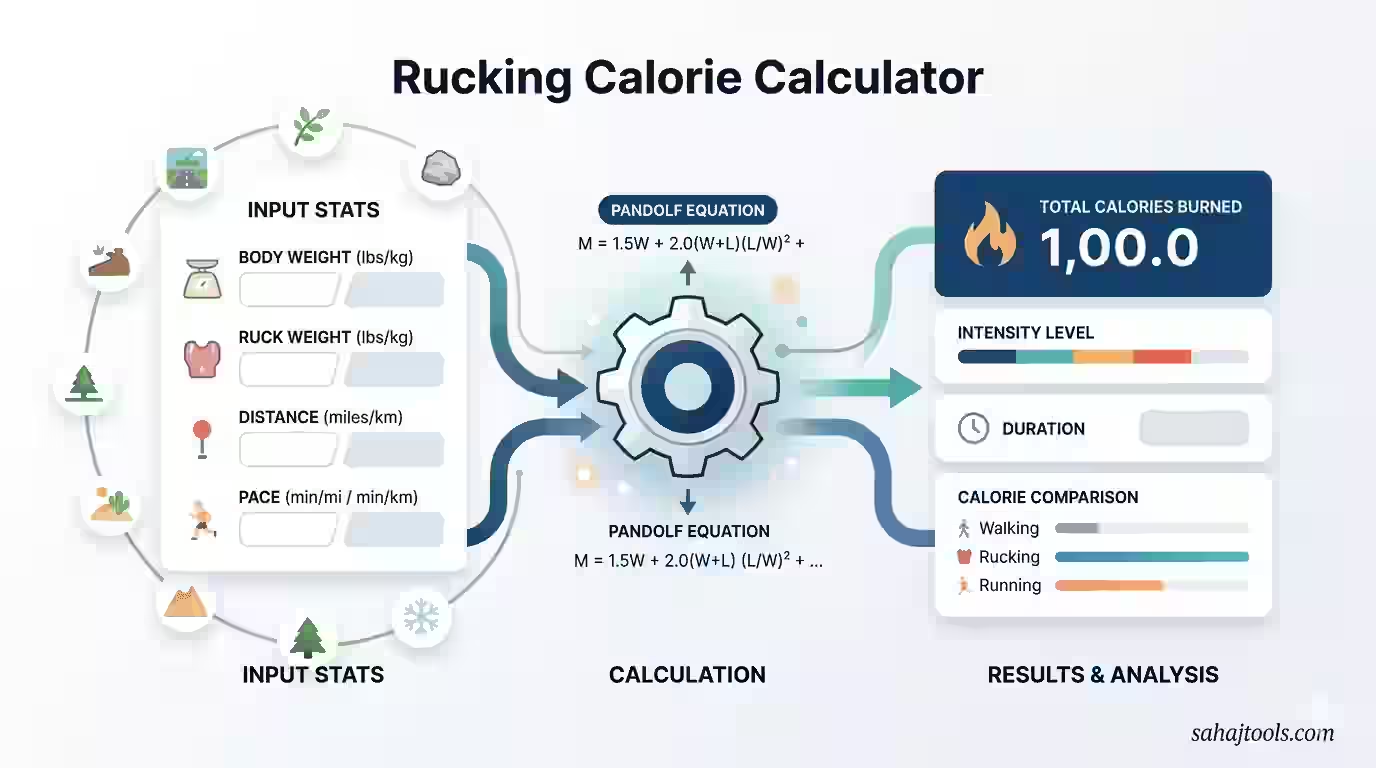
Pandolf Eq. M = 1.5W + 2.0(W+L)(L/W)² + η(W+L)(1.5V² + 0.35VG) + modern correction factor
Unlike standard calorie calculators that only account for body weight and distance, this tool factors in the added metabolic cost of load carriage — the extra energy your body spends stabilizing and moving a pack weight, which a plain walking calculator will underestimate.
How the Rucking Calorie Calculator Works
The calculator’s foundation is the Pandolf equation, a load-carriage energy expenditure formula developed for military and occupational research and published by the U.S. Army Research Institute of Environmental Medicine. It estimates metabolic rate (in watts, then converted to calories) as a function of body weight, external load weight, walking speed, terrain factor, and grade (incline).
At a conceptual level, the formula works like this:
Metabolic Rate = f(body weight + ruck weight, walking speed, terrain coefficient, grade)
The equation captures a key reality of load carriage: metabolic cost rises faster than linear as ruck weight increases, because your body must expend additional stabilizing energy on top of the raw work of moving the added mass. A 35-lb ruck doesn’t just add “35 lbs worth” of calories — the terrain, incline, and pace multiply that cost further.
Body weight and ruck weight are combined as the total load your musculoskeletal system moves over distance — heavier combined loads mean a higher metabolic rate at every pace.
Walking speed (pace) has a nonlinear relationship with energy cost. Moving from a 20-minute-mile shuffle to a 15-minute-mile pace under load increases calorie burn more than proportionally, which is why forced-march pace matters so much for energy planning.
Terrain factor (η) is a multiplier the Pandolf equation applies to account for surface difficulty. Pavement is the baseline (η = 1.0); loose sand or snow dramatically increases metabolic cost because more energy is lost to unstable footing rather than forward progress. The calculator’s terrain options — pavement, grass, dirt trail, sand, forest, and snow — reflect published coefficients from load-carriage research.
Grade (incline) adds or subtracts energy cost based on whether the route climbs or descends; uphill grades increase metabolic demand substantially, while gentle downhill grades can slightly reduce it (though steep descents reintroduce cost through braking and stabilization, which the calculator treats as a secondary correction beyond the base Pandolf term).
This calculator layers modern correction factors onto the classic Pandolf formula to keep results realistic across a wider range of paces and terrain than the original 1977 research alone would support, while staying grounded in the same load-carriage physiology.
How to Use the Rucking Calorie Calculator
- Choose your unit system — Imperial (lbs/mi) or Metric (kg/km) — using the toggle at the top.
- Enter your body weight in the Your Stats panel.
- Enter your ruck weight — the weight of your pack, plate carrier, or loaded rucksack, not including body weight.
- Enter distance in miles (or kilometers).
- Enter your pace in minutes per mile (or per kilometer). A pace of 18 min/mile is roughly 3.3 mph, a common ruck-march pace.
- Optionally set grade (%) if your route is uphill or downhill; leave at 0 for flat terrain.
- Optionally enter a duration if you know your total time — this overrides the pace-times-distance calculation.
- Select your terrain from the six available surfaces (pavement, grass, dirt trail, sand, forest, snow), each with its own terrain coefficient (η) displayed on the tile.
- Tap Calculate Calories to generate your personalized energy expenditure breakdown.
The result panel displays your estimated total calories burned, along with a breakdown by calories per mile and calories per hour, so you can plan fueling for a single ruck or an entire training block.
Worked Examples
Example 1 — Standard training ruck. A 170-lb soldier carries a 35-lb ruck for 3 miles at an 18-minute-mile pace on pavement (η = 1.0), flat grade. Using the Pandolf equation with these inputs, the combined load of roughly 205 lbs moving at a walking pace of 3.3 mph on flat, hard terrain produces a moderate but sustained metabolic rate — a realistic training-day ruck that most service members complete without excessive fatigue if conditioning is adequate.
Example 2 — Loaded ruck on sand with elevation. The same 170-lb soldier carries the same 35-lb ruck for 3 miles, but now on sand (η = 1.5) with a 5% uphill grade. Because sand’s terrain coefficient is 50% higher than pavement and the incline adds further metabolic cost, the estimated calorie burn for this ruck is substantially higher than Example 1 for the identical distance and load — illustrating why terrain and grade matter as much as raw distance when planning nutrition for a movement.
Interpreting Your Results
Your total calorie estimate reflects the added metabolic cost of carrying load over distance and terrain — it is not identical to a standard walking-calorie estimate, and it will typically read higher than a bodyweight-only walking calculator for the same distance.
Calories per mile is useful for comparing different ruck weights or terrains at a fixed distance — heavier loads and harder terrain will show a higher per-mile cost.
Calories per hour is the more useful figure for fueling strategy on longer rucks or events, since it lets you plan carbohydrate and fluid intake against expected duration rather than distance alone.
As a general orientation, ruck marches under moderate load on flat terrain tend to sit meaningfully above a comparable unloaded walk, and that gap widens sharply as ruck weight, pace, terrain difficulty, and grade increase together. If your result seems unusually low or high relative to how the ruck actually felt, double-check that your ruck weight excludes body weight and that your pace reflects your actual average, not your fastest split.
Standards & Formula Currency Notice
The Pandolf equation is a well-established load-carriage energy expenditure model originating from U.S. Army Research Institute of Environmental Medicine research, widely used in military and occupational physiology. This calculator applies that formula with added terrain and grade corrections for real-world accuracy. Official service-branch fueling guidance, ruck-march standards, and event-specific calorie requirements can vary by branch, unit, and year — always verify against your current official service-branch nutrition or physical-readiness guidance rather than treating this estimate as a substitute for command-issued standards.
This tool is for training and planning purposes and does not replace medical or nutritional guidance from a qualified professional, particularly if you have a medical condition affecting exercise tolerance, hydration needs, or caloric requirements.
Factors That Affect Your Rucking Calorie Estimate
Several variables shift your result beyond the core inputs:
- Fitness level and gait efficiency — a more conditioned rucker often moves more efficiently under load, which can modestly reduce actual energy cost versus the formula’s population-level estimate.
- Ruck fit and load distribution — a poorly fitted pack that shifts or sits low increases stabilizing effort beyond what the terrain coefficient alone captures.
- Ambient temperature and humidity — heat stress increases physiological strain and can raise real-world energy cost above the formula’s baseline.
- Footwear and ground conditions — boots, mud, and uneven surfaces not fully captured by the six terrain categories can push actual cost higher than estimated.
- Altitude — rucking at elevation increases metabolic demand beyond what flat-terrain, sea-level-based formulas predict.
Who Should Use This Calculator
- Active-duty service members planning fueling strategy for a scheduled ruck march or field training exercise.
- Recruits and applicants preparing for selection courses or fitness assessments that include a loaded ruck component.
- Reservists and National Guard members training independently for annual fitness testing standards.
- Civilians training for GORUCK events, Special Forces selection prep, or rucking fitness programs who want a load-carriage-specific calorie estimate rather than a generic walking calculator.
- Coaches and trainers programming ruck-based conditioning blocks who need to estimate energy demands across varying loads and terrain.
related health & fitness calculator
frequently asked question (FAQ)
Calories burned rucking depend on body weight, ruck weight, distance, pace, terrain, and grade — there's no single fixed number. A typical training ruck (moderate load, flat terrain, walking pace) burns noticeably more than an unloaded walk of the same distance, with the exact figure varying by hundreds of calories depending on load and terrain.
Heavier ruck weight increases calorie burn faster than a simple linear relationship, because your body spends extra energy stabilizing the added load, not just moving it. Doubling your ruck weight typically more than doubles the added metabolic cost compared to rucking unloaded.
The Pandolf equation is a load-carriage energy expenditure formula developed by the U.S. Army Research Institute of Environmental Medicine that estimates metabolic rate from body weight, load weight, walking speed, terrain, and grade. It remains one of the most widely referenced formulas for estimating the metabolic cost of carrying weight over distance.
Rucking burns more calories than walking the same distance at the same pace because the added ruck weight increases the total load your body must move and stabilize. It's a strategic way to increase calorie expenditure and training stimulus without necessarily increasing pace or distance.
Rucking calorie calculators using the Pandolf equation provide a research-based estimate, not a lab-measured figure — actual energy cost varies with individual fitness, gait efficiency, temperature, and footwear. They're best used for comparing rucks against each other and planning fueling strategy, not as a precise clinical measurement.
Calories per mile while rucking depend heavily on ruck weight and terrain — a heavier load or harder surface (sand, snow) raises the per-mile cost compared to pavement at the same weight. This calculator's results panel breaks out a per-mile figure so you can compare different load and terrain combinations directly.
Calories per hour depend on your pace as well as load and terrain, since a faster ruck march covers more distance — and does more work — in the same amount of time. This figure is generally more useful than calories-per-mile for planning fueling during events or longer training sessions with a fixed time budget.
Sources & Further Reading
This calculator’s methodology is based on the Pandolf load-carriage equation, originating from U.S. Army Research Institute of Environmental Medicine research on metabolic cost during load carriage. For official ruck-march standards, fueling guidance, and fitness testing requirements specific to your branch, consult your current service-branch physical readiness training publications and command guidance, since these standards are updated periodically.
Last Update: July 2026