
Table of Contents
ToggleEngine Size Calculator
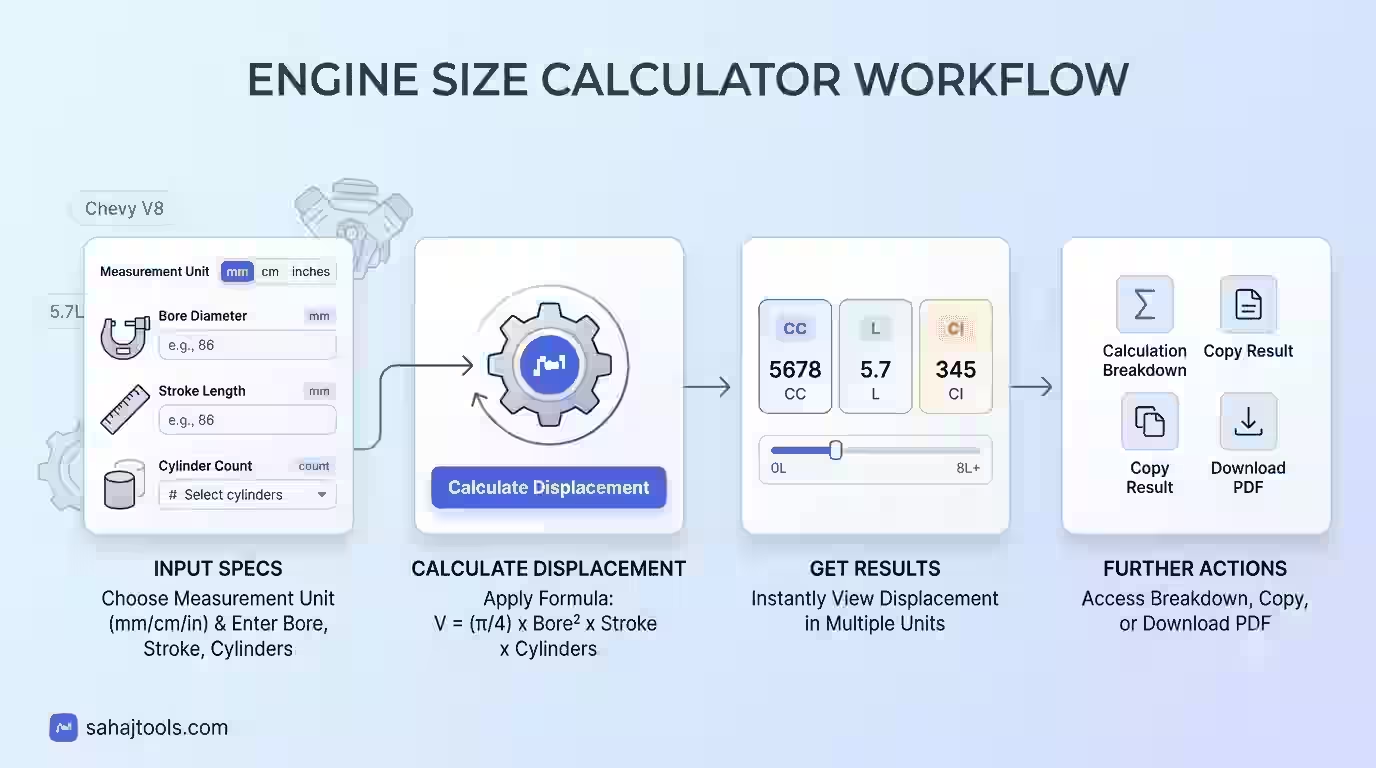
Enter your engine’s bore diameter, stroke length, and cylinder count to instantly calculate displacement in cubic centimeters, liters, and cubic inches. This engine size calculator uses the standard swept-volume formula that engine builders and manufacturers rely on, so you get an accurate number whether you’re checking a spec sheet or planning a rebuild.
Engine Size Calculator
Displacement in CC · Liters · Cubic Inches
✦ Engineering Accurate
Formula
V = (π/4) × Bore² × Stroke × Cylinders
Ready to Calculate
Enter bore, stroke, and cylinders on the left — your engine displacement will appear here instantly.
Try a reference engine:
Displacement Results
cc
Cubic Centimeters—cc
L
Liters—L
ci
Cubic Inches—cu in
0L1L3L5L8L+
∑ Calculation Breakdown
⚠
Reset Calculator?
All inputs and results will be cleared. This cannot be undone.
✓Copied to clipboard!
related automotive & transport calculators
How to Use This Calculator
- Select your preferred measurement unit — millimeters, centimeters, or inches.
- Enter the bore diameter (the cylinder’s inner diameter).
- Enter the stroke length (the distance the piston travels inside the cylinder).
- Select the number of cylinders in the engine.
- Click “Calculate Displacement” to get results in cc, liters, and cubic inches at once.
- Use the reference-engine shortcuts (2.0L BMW, 5.7L V8, Chevy V8) to check the tool against known values.
How Engine Displacement Is Calculated
Engine displacement is the total volume swept by all pistons as they move from the bottom to the top of their cylinders. A bore and stroke calculator like this one applies one formula per cylinder, then multiplies by cylinder count:
V = (π/4) × Bore² × Stroke × Cylinders
- Bore diameter — the internal width of the cylinder, measured across its bore.
- Stroke length — the distance the piston travels from bottom dead center to top dead center.
- Cylinders — the total number of combustion chambers in the engine.
Worked Example
Take a bore of 86 mm and a stroke of 86 mm across 4 cylinders — close to a common four-cylinder passenger-car layout:
- Volume per cylinder = (π/4) × 86² × 86 = 499,732 mm³ ≈ 499.7 cc
- Total displacement = 499.7 cc × 4 ≈ 1,999 cc, or about 2.0 liters
- Converted to cubic inches: 1,999 cc ÷ 16.387 ≈ 122 cu in
This is why a “2.0L” badge on a compact sedan typically corresponds to roughly 122 cubic inches — the same swept volume, expressed in three different unit systems.
A V8 Example
A classic 5.7-liter V8 (350 cubic inches in the old Chevy small-block convention) uses a bore around 101.6 mm (4.00 in) and a stroke around 88.4 mm (3.48 in) across 8 cylinders:
- Volume per cylinder = (π/4) × 101.6² × 88.4 ≈ 716,900 mm³ ≈ 717 cc
- Total displacement ≈ 717 cc × 8 ≈ 5,735 cc, close to the nominal 5.7L rating
- In cubic inches: 5,735 cc ÷ 16.387 ≈ 350 cu in
Converting Between CC, Liters, and Cubic Inches
Once you have raw displacement in cubic centimeters, converting to other units is straightforward:
- CC to liters: divide by 1,000 (e.g., 1,999 cc ÷ 1,000 = 1.999 L)
- CC to cubic inches: divide by 16.387 (e.g., 5,735 cc ÷ 16.387 ≈ 350 cu in)
- Cubic inches to cc: multiply by 16.387
North American engines are traditionally marketed in cubic inches (302, 350, 454) or liters, while European and Asian manufacturers almost always use liters or cc. This calculator reports all three simultaneously so you don’t need a separate liters-to-cc calculator or cubic inch calculator for cross-referencing spec sheets.
What the Result Means
Displacement doesn’t tell you horsepower directly, but it’s the single biggest factor in an engine’s baseline air intake — and therefore its potential to burn fuel and produce power. A larger engine capacity in cc generally means more torque at lower RPM, while a smaller-displacement engine paired with turbocharging can match output through boost instead of volume. When you’re comparing engine capacity calculator results across two vehicles, remember that displacement alone doesn’t account for forced induction, compression ratio, or valve timing — all of which shift real-world output independent of swept volume.
Factors That Affect the Result
- Bore vs. stroke ratio — “oversquare” engines (bore larger than stroke) tend to rev higher; “undersquare” engines (stroke larger than bore) favor low-end torque.
- Cylinder count and layout — inline, V, flat, and rotary layouts all use the same displacement math per cylinder, but packaging and balance differ.
- Manufacturing tolerances — real-world bore and stroke can vary slightly from spec, which is why an engine’s actual measured displacement occasionally differs by a few cc from its advertised figure.
- Unit rounding — manufacturers often round displacement for marketing (a “2.0L” engine may measure 1,998 cc or 1,999 cc precisely).
Fitment and Safety Note
This tool calculates theoretical swept volume from the dimensions you enter — it does not measure your actual engine or verify machining tolerances. If you’re calculating displacement for an engine build, bore, or stroke modification, confirm your final bore and stroke measurements with a machinist or manufacturer specification before ordering parts, as small dimensional errors compound significantly in a cylinder volume calculation.
Frequently Asked Questions
Multiply the volume of one cylinder — (π/4) × bore² × stroke — by the total number of cylinders. The result is the engine's total swept volume, usually expressed in cc, liters, or cubic inches.
Engine size in cc is the total volume, in cubic centimeters, that all pistons displace during one complete stroke cycle. It's the metric-system equivalent of liters or cubic inches.
Bore is the internal diameter of a cylinder; stroke is the distance the piston travels inside that cylinder from bottom to top. Together they determine the volume swept per cylinder.
Displacement grows with the square of the bore but only linearly with stroke, so increasing bore diameter has a larger effect on total engine size than increasing stroke by the same amount.
Divide cubic centimeters by 1,000. For example, 1,999 cc equals 1.999 liters, commonly rounded to 2.0L.
Multiply cubic inches by 16.387. A 350 cubic inch V8, for instance, equals roughly 5,735 cc.
Swept volume is another term for engine displacement — the total volume displaced by all pistons moving through one full stroke, excluding the combustion chamber volume above the piston at top dead center.
Enter all three values into the formula (π/4) × bore² × stroke × cylinders. This calculator does that automatically and returns the result in cc, liters, and cubic inches at once.
They're generally used interchangeably. "Engine size" is the everyday term; "displacement" is the precise engineering term for the same swept-volume measurement.
The formula is identical regardless of cylinder layout — only the cylinder count changes. A V6, V8, and inline-6 with the same bore and stroke per cylinder will have displacement that scales purely with the number of cylinders.
Last Update: August 2026