
Table of Contents
ToggleFuel Injector Calculator: Size Injectors for Any Horsepower Goal
Picking the wrong injector size is one of the fastest ways to stall a build — too small and you lean out under boost, too big and idle quality and drivability suffer. A fuel injector calculator takes the guesswork out of that decision by turning your target horsepower, cylinder count, induction type, and fuel choice into a required flow rate in lb/hr and cc/min, so you know exactly what to shop for.
Fuel Injector Calculator
Professional injector sizing & duty cycle analysis
Engine Parameters
Fuel System
%
Use auto BSFC
lb/HP/hr
Enter your engine parameters and click Calculate to get precise injector sizing recommendations.
Calculation Results
—cc/min
—lb/hr
Required Injector Flow Rate
BSFC Used—lb/HP/hr
Actual Duty Cycle—%
Total Fuel Flow—lb/hr
Pressure Factor—×
HP Support at Common Injector Sizes
💡
Reset Calculator?
This will clear all inputs, results, and saved session data. This cannot be undone.
Result copied to clipboard!
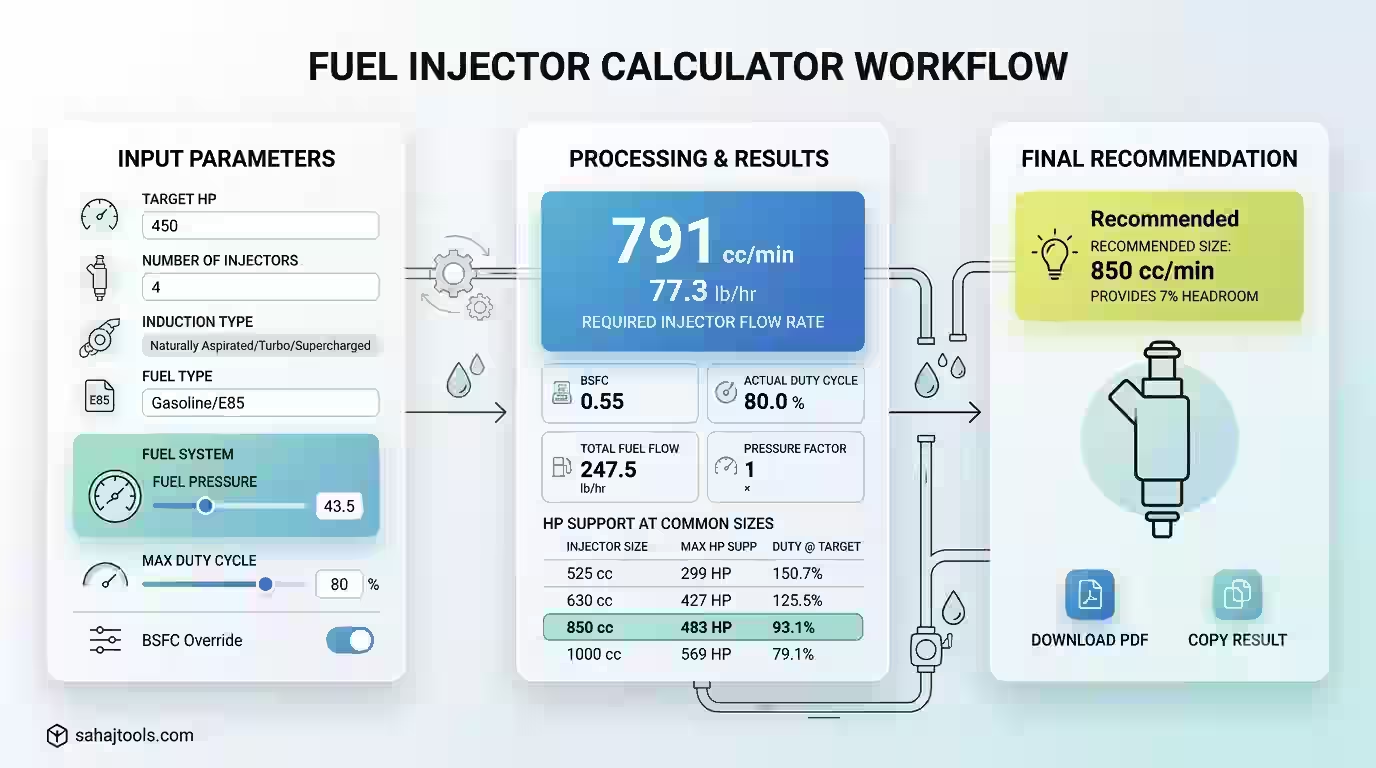
Required injector flow (lb/hr) = (Target HP × BSFC) ÷ (Number of Injectors × Max Duty Cycle). For a 450 hp naturally aspirated V8 on gasoline at 0.55 BSFC and 80% duty cycle, that works out to roughly 77 lb/hr per injector, or about 791 cc/min — pointing you toward an 850 cc/min injector for safe headroom.
related automotive & transport calculators
How Fuel Injector Sizing Actually Works
Every injector size calculator is built around the same core relationship: the engine needs a certain mass of fuel per hour to support a given horsepower level, and that fuel has to be split evenly across however many injectors are firing. The calculator’s job is just doing that division correctly and converting the result into units you can shop with.
The core formula:
- Injector Flow Rate (lb/hr) = (HP × BSFC) ÷ (Number of Injectors × Duty Cycle)
- Injector Flow Rate (cc/min) = (HP × BSFC ÷ Number of Injectors × 10.5) ÷ (Duty Cycle % ÷ 100)
- Conversion: 1 lb/hr ≈ 10.5 cc/min
BSFC (brake specific fuel consumption) is the pounds of fuel an engine burns per horsepower per hour — it’s the variable that ties horsepower to fuel volume, and it changes with induction type and fuel. Duty cycle is the percentage of time the injector is actually open during each firing cycle; running injectors at 100% duty cycle removes any margin for tuning, temperature swings, or a slightly rich map, which is why every credible fuel system design keeps daily-driven cars under about 80% and race applications under roughly 85–90%.
What to Enter: Inputs and Outputs
A well-built fuel injector flow rate calculator asks for six things: target horsepower, number of injectors, induction type (naturally aspirated, turbocharged, or supercharged), fuel type, base fuel pressure, and maximum duty cycle — with an optional BSFC override for tuners who already know their engine’s actual fuel efficiency rather than relying on an estimate.
The output side gives you the number that matters (required flow in lb/hr and cc/min) alongside supporting figures: total fuel flow across all injectors, the duty cycle you’ll actually run at your chosen injector size, and a pressure adjustment factor if your rail pressure differs from the injector’s rated pressure.
A useful fuel injector size calculator will also show a reference table of common injector sizes against the horsepower they support at your target duty cycle, since real-world injectors come in fixed increments (440, 550, 630, 750, 850, 1000, 1200, 1600 cc/min) rather than the exact number the math produces — you’re always rounding up to the nearest available size.
Crank HP or Wheel HP? Get This Right First
This is the single most common sizing mistake. Crank horsepower is what the engine produces at the flywheel; wheel horsepower (often called rear-wheel HP or RWHP) is what actually reaches the ground after drivetrain losses of roughly 15–20% for most manual and automatic setups. If you enter a dyno’s wheel HP number into a calculator expecting crank HP, you’ll undersize your injectors — sometimes by a meaningful margin on a car making 600+ hp.
The rule of thumb: if your horsepower figure came from a manufacturer spec sheet or an engine dyno, it’s crank HP and can be entered directly. If it came from a chassis dyno pull, add back roughly 15–20% before entering it, or use a dedicated crank-to-wheel conversion if your platform’s drivetrain loss is documented more precisely.
Fuel Type Changes Everything: Gasoline, E85, and Methanol
Switching fuels doesn’t just change the BSFC number — it changes how much bigger your injectors need to be for the same horsepower target, because ethanol and methanol carry less energy per gallon than gasoline and burn richer.
- Gasoline (pump gas or race gas): BSFC baseline of 0.45–0.50 lb/hp/hr naturally aspirated, 0.55–0.65 boosted.
- E85 (85% ethanol): Needs roughly 30% more flow than gasoline at the same horsepower, with BSFC around 0.65–0.75 lb/hp/hr.
- Methanol: Needs roughly double the flow of gasoline — BSFC lands near 1.0–1.2 lb/hp/hr, which is why methanol racing applications almost always require injectors a full size class larger, or more injectors, than an equivalent gasoline build.
- Ethanol blends (E30, E50): Scale roughly linearly between gasoline and E85 — a rough estimate is to interpolate BSFC by blend percentage, though a tune-specific BSFC override is more accurate once you have real data.
A calculator built for this should let you pick a fuel preset rather than forcing you to look up BSFC ranges manually every time you change fuel plans.
Worked Examples
Example 1 — 450 hp naturally aspirated V8, pump gasoline, 4 injectors. BSFC 0.55 lb/hp/hr, 80% max duty cycle: (450 × 0.55) ÷ (4 × 0.80) = 77.3 lb/hr per injector, or about 791 cc/min. The nearest common size, 850 cc/min, leaves roughly 7% flow headroom and runs at about 74% duty cycle at this power level rather than maxing out at 80% — real margin for a slightly rich tune or hot-weather enrichment.
Example 2 — 800 hp turbocharged inline-4 (e.g., a built K-series or 2JZ-style application) on E85, 4 injectors. With boosted E85 BSFC around 0.70 lb/hp/hr and an 85% race duty cycle target: (800 × 0.70) ÷ (4 × 0.85) = 164.7 lb/hr per injector, or roughly 1,730 cc/min — pushing this build toward the 1600–2000 cc/min injector class, well beyond what a gasoline-only 800 hp build would need.
Those two scenarios show why entering the wrong fuel type or duty cycle target isn’t a small error — it can put you a full injector size class off.
Platform Examples: LS, Coyote, K-Series, 2JZ, RB26
Popular swap and built-engine platforms tend to cluster around familiar horsepower brackets, which makes a fuel injector calculator for LS, Coyote, or K-series builds especially useful for sanity-checking a parts list before you buy:
- LS-based V8s (4–8 injectors): Common naturally aspirated builds in the 400–500 hp range typically land in the 550–750 cc/min class on gasoline; boosted LS builds pushing 700–900 hp often move to 1000–1200 cc/min.
- Coyote 5.0 V8: Similar flow needs to LS at equivalent power, though factory direct-injection Coyotes require different sizing logic than port-injected swaps.
- Honda K-series (K20/K24, 4 injectors): High-revving, lower-displacement — turbo K-series builds in the 400–600 hp range commonly need 1000cc+ injectors given the lower cylinder count sharing the total flow.
- Toyota 2JZ and Nissan RB26 (inline-6): Popular drift and drag platforms; a 600 hp 2JZ on pump gas with 6 injectors needs meaningfully less per-injector flow than an equivalent 4-cylinder build, since the load is split six ways instead of four.
Beyond Injectors: Sizing Your Fuel Pump
Injectors are only half of a fuel system — an undersized fuel pump will starve even correctly-sized injectors under load. Total system fuel flow needs to account for the pump’s flow rating at your actual fuel pressure (pump flow drops as pressure rises), plus enough headroom that the pump itself isn’t running at 100% duty cycle. As a starting point, size the pump for your calculated total fuel flow (all injectors combined) plus roughly 20% margin, and check the pump manufacturer’s flow curve at your target base fuel pressure rather than assuming the advertised flow-at-zero-pressure number.
Fuel pressure regulators matter here too: a rising-rate regulator increases fuel pressure with boost, which increases injector flow beyond its rated static value — a detail worth accounting for separately if your build is boosted, since it effectively adds flow capacity without a bigger injector.
Safe Duty Cycle by Use Case
Duty cycle targets should shift with how the car is actually driven:
- Daily driver / street car: Keep max duty cycle at or under 80% to preserve margin for cold starts, hot-soak enrichment, and normal tune variance.
- Street/strip and track day cars: 80–85% is a reasonable working ceiling, since these cars still see varied conditions.
- Dedicated drag racing: 85–90% is more commonly accepted since the car runs a fixed, well-tested tune under consistent, controlled conditions.
Running above roughly 90% duty cycle on any application removes the margin injectors need to respond linearly, which can show up as tuning instability at the top of the rev range.
Frequently Asked Questions
Multiply your target horsepower by your fuel's BSFC, then divide by the number of injectors times your maximum duty cycle (as a decimal). Round the result up to the next available commercial injector size.
Naturally aspirated gasoline engines typically run 0.45–0.50 lb/hp/hr; boosted gasoline engines run richer at 0.55–0.65 lb/hp/hr because forced induction increases fuel demand per horsepower.
80% is the standard ceiling for street-driven cars; dedicated race applications with a fixed tune can safely run 85–90%.
Roughly 30% more flow at the same horsepower target, driven by E85's higher BSFC.
Roughly double the flow of gasoline at the same horsepower, since methanol's BSFC is close to 1.0–1.2 lb/hp/hr versus gasoline's 0.45–0.65.
Multiply lb/hr by 10.5 to get cc/min; divide cc/min by 10.5 to get lb/hr. This conversion assumes gasoline's density — fuels with different densities shift the exact factor slightly.
Use crank HP. If you only have a wheel HP dyno number, add back roughly 15–20% for typical drivetrain loss before entering it.
Injector flow rate is rated at a specific base pressure; raising fuel pressure increases actual flow above the rated static number, while lowering it decreases flow — which is why matching your rail pressure to the injector's rated pressure matters for accurate sizing.
Match the number of injectors to your cylinder count for standard port injection (four for a 4-cylinder, eight for a V8), unless you're running a batch-fire or auxiliary injector setup, which changes the flow-per-injector math.
It depends heavily on fuel and induction type, but as a gasoline, naturally aspirated reference point: 500 hp lands near 630–750 cc/min, 600 hp near 750–850 cc/min, 800 hp near 1000–1200 cc/min, and 1000 hp near 1200–1600 cc/min — always confirm with the calculator using your actual cylinder count and duty cycle target.
Size the pump to your total combined injector flow (not per-injector flow) plus roughly 20% margin, checked against the pump's flow rating at your actual base fuel pressure rather than its zero-pressure spec.
Flow rate (lb/hr) = (Horsepower × BSFC) ÷ (Number of Injectors × Max Duty Cycle), with a straightforward ×10.5 conversion to cc/min.
Yes — the same formula applies whether you're building a new EFI system from scratch or converting a carbureted engine; just make sure your target horsepower and fuel type inputs reflect the finished, tuned engine rather than a rough estimate.
For daily driving, size injectors so your calculated duty cycle stays under 80% at your realistic power target, leaving room for cold starts and enrichment; for drag racing, sizing closer to an 85–90% duty cycle ceiling is acceptable since the tune and conditions are fixed and repeatable.
Interpolate BSFC roughly linearly between gasoline and E85 based on blend percentage as a starting estimate, then refine with a BSFC override once you have real tuning data for your specific blend.
Run your own numbers through the calculator above with your actual horsepower goal, fuel type, and duty cycle target — it takes the formula above and does the rounding and unit conversion for you, so you land on a real, shoppable injector size rather than an estimate you have to convert by hand.
This calculator provides an engineering estimate based on standard BSFC ranges and duty cycle targets. Actual fuel requirements vary with tune quality, altitude, fuel quality, and engine condition — verify sizing with a professional tuner before finalizing a fuel system purchase, especially for boosted or alcohol-fuel applications where undersizing carries real risk of a dangerously lean condition.
Last Update: August 2026