
Table of Contents
ToggleConcrete Cost Calculator: Estimate Your Project's Cubic Yards and Price
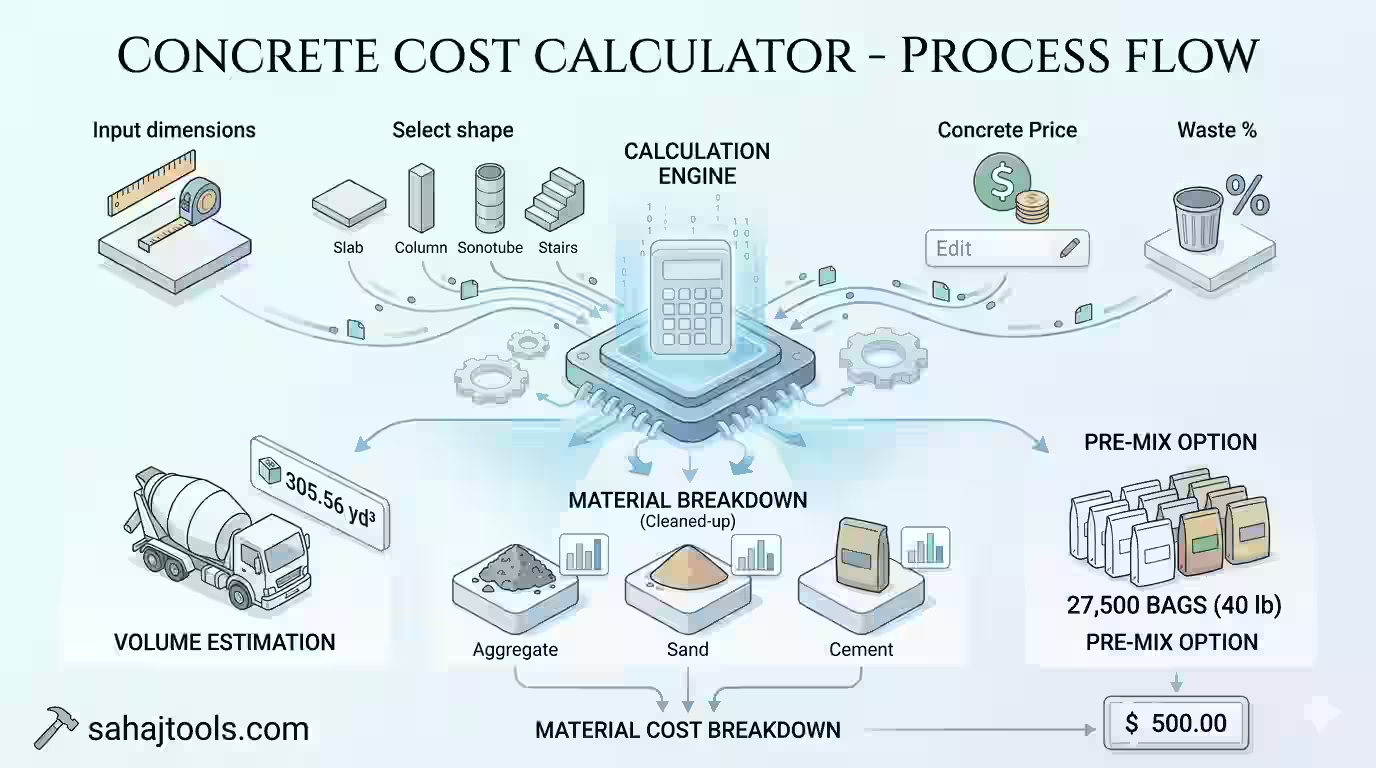
Pouring concrete without knowing the volume first is how projects end up with a wasted delivery fee or a short load. A concrete cost calculator takes your slab, footing, or column dimensions and converts them into the numbers that actually matter before you order: cubic yards, bag count, and total price. Whether you’re pricing a driveway, a patio, or a small footing, getting the volume right the first time is the difference between one clean delivery and a frustrating second trip to the supplier.
Concrete Cost Calculator
Accurate volume, material, and cost estimation for any concrete project
Please fix the following:
Select Shape
Dimensions & Units
Pricing & Waste
$/yd³
10%
Add pre-mix bag prices (optional)
$/bag
$/bag
$/bag
Results Summary
Volume Breakdown
| Description | Cubic Yards | Cubic Feet | Cubic Metres |
|---|
Pre-Mix Bags Required
* Based on standard yields: 40lb=0.30 ft³ · 60lb=0.45 ft³ · 80lb=0.60 ft³
Material Breakdown (1:2:3 Mix Ratio)
| Material | Pounds (lb) | Kilograms (kg) | Notes |
|---|
Reset Calculator?
All inputs and results will be cleared. This cannot be undone.
This guide walks through how the calculator works, a full worked example, a bag-yield reference table, and the common mistakes that trip people up when estimating a concrete slab cost calculator project.
Similar construction & material calculator
How a Concrete Cost Calculator Works
At its core, every concrete volume calculation follows the same logic: length × width × thickness, converted from cubic feet into cubic yards (since ready-mix concrete is priced and delivered by the yard). The formula changes shape slightly depending on the pour:
- Slabs, patios, and driveways (rectangular prism): Length (ft) × Width (ft) × Thickness (ft) ÷ 27 = cubic yards
- Columns and sonotubes (cylinder): π × radius² × height ÷ 27 = cubic yards
- Footings and stairs: broken into rectangular or stepped segments, then summed
Thickness is usually the number people guess wrong. A standard patio or walkway slab runs 4 inches thick, while a driveway meant to carry vehicle weight is typically poured at 5–6 inches. Convert inches to feet before plugging into the formula (4 inches = 0.33 ft).
Once you have raw cubic yards, a good calculator layers in three more things: a waste allowance, a price per cubic yard (or per bag, if you’re hand-mixing), and any delivery or short-load fee the ready-mix supplier charges.
Quick answer: For a standard 10×10 ft patio slab poured 4 inches thick, you’ll need about 1.23 cubic yards of concrete before waste allowance — roughly 1.35 yards once a typical 10% overage is added.
Worked Example: 10×10 Foot Patio Slab
Let’s walk through a real concrete patio cost calculation from start to finish.
Project: A 10 ft × 10 ft patio slab, 4 inches thick.
- Convert thickness to feet: 4 ÷ 12 = 0.33 ft
- Calculate volume: 10 × 10 × 0.33 = 33 cubic feet
- Convert to cubic yards: 33 ÷ 27 = 1.22 cubic yards
- Add a 10% waste allowance: 1.22 × 1.10 = 1.34 cubic yards
- Apply pricing: at $150 per cubic yard for ready-mix, delivered material cost = 1.34 × $150 = $201
If a short-load fee applies (most ready-mix suppliers charge one for orders under 3–5 cubic yards, since a full mixer truck holds around 10 yards), add that separately — it’s commonly $50–$100 on top of material cost. Add placement and finishing labor, and the installed cost for this same slab typically lands between $6 and $8 per square foot in most markets, or roughly $600–$800 total for this 100-square-foot patio.
Concrete Yield and Bag Reference Table
If you’re hand-mixing with bagged concrete instead of ordering ready-mix, use this table to convert your cubic-yard total into bag count. This is the reference most bagged concrete calculator searches are looking for.
Bag Size | Yield per Bag | Bags per Cubic Yard |
40 lb | 0.011 cu yd (~0.30 cu ft) | ~90 bags |
60 lb | 0.017 cu yd (~0.45 cu ft) | ~60 bags |
80 lb | 0.022 cu yd (~0.60 cu ft) | ~45 bags |
For the 1.34-cubic-yard patio example above, that’s roughly 121 bags of 40 lb mix, 81 bags of 60 lb mix, or 61 bags of 80 lb mix. For anything over about 1 cubic yard, ready-mix delivery is almost always cheaper and far less physical labor than mixing dozens of bags by hand.
Waste Allowance: Why You Should Always Order Extra
Add 5–10% for spillage, uneven ground, and settling. Sub-base grading is rarely perfectly flat, forms can bow slightly under pressure, and a bit of material is always lost in transfer from the truck or mixer to the forms. Ordering the bare-minimum calculated volume is the single most common reason people end up short mid-pour — and a second short-load delivery costs far more than the extra half-yard would have.
A Note on Regional Units
If you’re estimating a concrete calculator uk or concrete calculator ireland project, keep in mind that concrete in the UK and Ireland is typically priced and ordered in cubic metres rather than cubic yards, and mix strength is expressed as an N/mm² grade rather than PSI. The volume formula itself — length × width × thickness — works the same either way; you’re just skipping the ÷27 conversion and going straight from cubic feet (or metres) to your local ordering unit.
Ready-Mix vs. Pre-Mixed Bags
For small pours — a fence post base, a mailbox footing, a single stepping stone — bags of pre-mixed concrete are usually the simpler and cheaper option, since ordering a ready-mix truck for less than half a yard rarely makes financial sense once the short-load fee is factored in. Once a project crosses roughly 1 cubic yard, ready-mix delivery from a concrete mixer truck typically wins on both cost per yard and labor saved, and it’s the only realistic option for anything at driveway or foundation scale.
Common Mistakes to Avoid
- Forgetting to convert thickness to feet. Plugging in “4” instead of “0.33” for a 4-inch slab inflates the volume by 12x.
- Skipping the waste allowance. A bare-minimum order is a common cause of running short mid-pour.
- Confusing PSI mix strength with volume. A higher PSI mix (used for driveways expected to handle vehicle loads) doesn’t change how much concrete you need — only its strength and cost per yard.
- Ignoring rebar or wire mesh reinforcement in the cost estimate. Reinforcement adds a small but real line item to total project cost, separate from the concrete volume itself.
- Not accounting for irregular shapes. An L-shaped patio or a garage slab with a stepped foundation edge needs to be split into separate rectangular sections and summed, not treated as one uniform block.
Frequently Asked Questions
A cubic yard of standard ready-mix concrete weighs approximately 4,050 pounds (roughly 2 tons), though the exact figure varies slightly with the specific mix design and aggregate used.
Ready-mix concrete typically runs $125–$180 per cubic yard for material alone, before delivery, short-load fees, or labor. Costs vary by region and current material pricing, so always confirm with a local supplier before budgeting a project.
A standard concrete mixer truck holds around 10 cubic yards, though capacity can range from about 8 to 11 yards depending on the truck and supplier.
It takes approximately 60 bags of 60 lb pre-mixed concrete to make one cubic yard.
A standard pallet typically holds 42 bags of 80 lb concrete, or around 56–60 bags of 60 lb concrete, though pallet count varies by manufacturer and packaging.
One cubic yard covers 81 square feet at a 4-inch thickness, or 108 square feet at a 3-inch thickness — coverage scales inversely with slab thickness.
A basic concrete slab typically costs $4–$8 per square foot installed, including material, delivery, and standard finishing labor, though reinforced or decorative finishes push that higher.
A short-load fee is an extra charge, commonly $50–$100, that ready-mix suppliers apply to orders below their minimum threshold (often 3–5 cubic yards) since a partially filled truck still costs the same to dispatch.
Order 5–10% more than your calculated volume to account for spillage, uneven sub-base grading, and minor settling during the pour.
Before you start, gather three measurements: length, width, and thickness of your pour area (or radius and height, if you’re pouring a column or sonotube). Plug those into the calculator above along with your local price per cubic yard, and you’ll have a delivery-ready number in seconds — no manual conversion required.
If you’re also estimating materials for the ground beneath your slab, a gravel driveway calculator can help you figure out the sub-base layer, and if reinforcement is part of your plan, checking rebar spacing separately will round out your full material budget.
Last Update: August 2026