
Table of Contents
ToggleIllinois Maintenance Calculator: Estimate Your Spousal Support
Divorce brings enough uncertainty without having to guess what spousal support might look like. An Illinois maintenance calculator — sometimes searched for as an illinois alimony calculator or illinois spousal support calculator — gives you a starting point: a statutory estimate of monthly maintenance and its likely duration, based on the same guideline formula Illinois courts use as their baseline. Whether you’re the likely payor or the likely recipient, understanding this number early can make conversations with your attorney, mediator, or former spouse far more grounded.
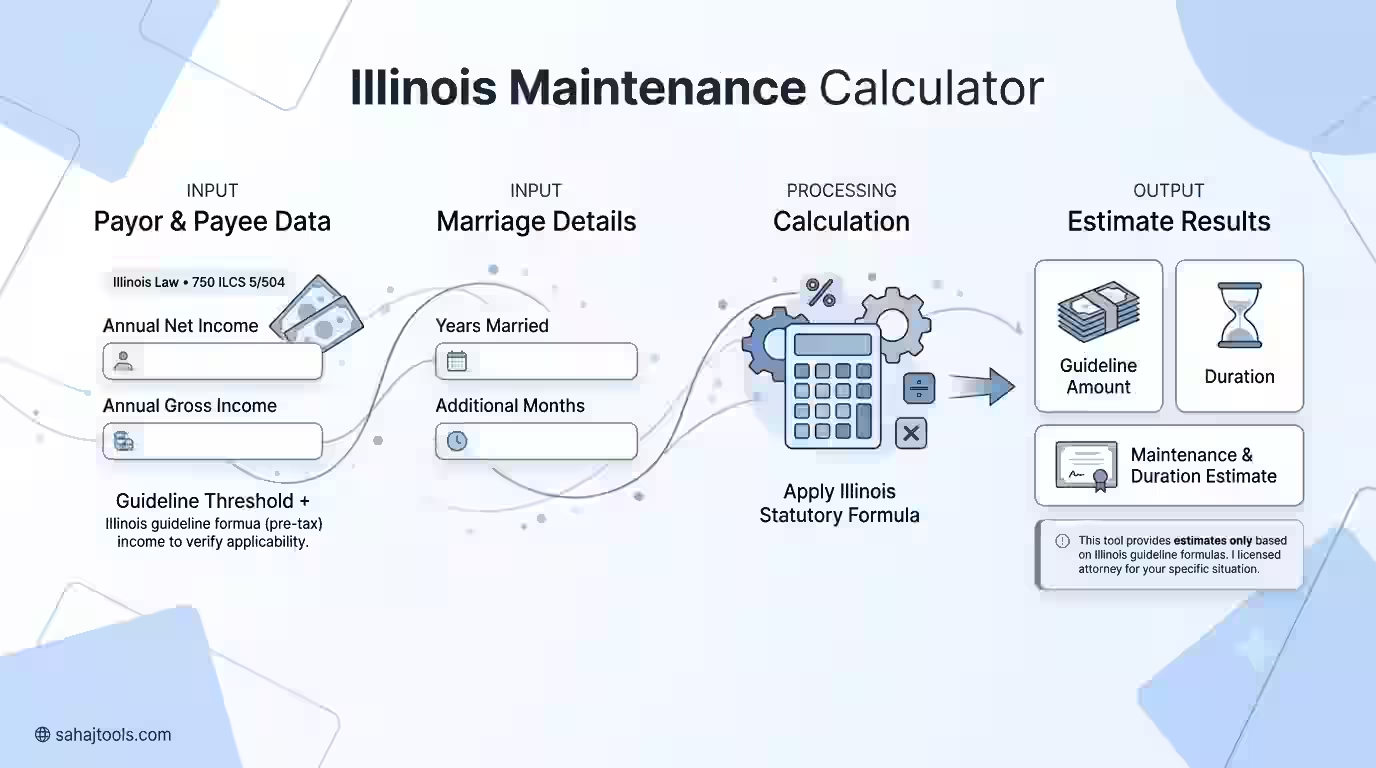
Illinois Law · 750 ILCS 5/504
Spousal Maintenance Calculator
Estimate guideline maintenance amount & duration based on Illinois statutory formula
This tool provides estimates only based on Illinois guideline formulas. Results are not legal advice. Consult a licensed attorney for your specific situation.
Based on Illinois statute 750 ILCS 5/504 · For educational purposes only · Not legal advice
Reset Calculator?
This will clear all inputs, results, and saved session data. This action cannot be undone.
This is different from an Illinois child support calculator, even though the two often get discussed together. Maintenance (what many people still call alimony) is money paid from one spouse to the other based on the income gap between them. Child support is calculated separately, based on both parents’ incomes and parenting time, and is meant to cover a child’s needs rather than support a former spouse’s standard of living. Many Illinois cases involve both, and the order in which they’re calculated actually matters — more on that below.
related finance & business calculators
How Illinois Maintenance Is Calculated
Illinois uses a statutory guideline formula, found in 750 ILCS 5/504 of the Illinois Marriage and Dissolution of Marriage Act, to estimate maintenance when the parties’ combined gross income falls under a set threshold — currently $500,000. Above that threshold, or in cases with unusual facts, the formula is only a reference point, and the court has broader discretion.
The Illinois maintenance formula works in two parts: an amount calculation and a duration calculation. Any spousal maintenance calculator built on this formula will ask for the same core inputs.
Amount: The guideline amount is calculated by taking 33.33% of the payor’s net income and subtracting 25% of the payee’s net income. The result is capped so that the recipient’s total income (their own income plus maintenance) doesn’t exceed 40% of the couple’s combined net income. This income-shares style approach — sometimes referred to loosely as an income shares model — is designed to narrow, but not eliminate, the gap between the two households’ post-divorce standards of living.
Duration: Duration is tied to the duration of marriage, using a statutory multiplier that increases in bands as the marriage lengthens — for example, marriages under five years use a smaller multiplier than marriages of fifteen, twenty, or more years. For marriages of 20 years or longer, a court may order maintenance for a period equal to the length of the marriage, or order it permanently, at its discretion.
Because the formula relies on net income, not gross income, one of the most common points of confusion is figuring out which number to enter — we’ll clarify that in the FAQ below.
Statutory Factors Illinois Courts Consider
Even where the guideline formula applies, Illinois law directs courts to weigh a broader set of factors before finalizing a maintenance obligation. These factors matter most when a case falls outside the guideline threshold, or when either spouse asks the court to deviate from the formula.
Factor | What It Considers |
Income and property | Each spouse’s income, assets, and needs, including marital and non-marital property |
Earning capacity | Realistic future earning potential, not just current income |
Standard of living | Standard established during the marriage |
Duration of marriage | Length of the marriage, tied directly to the duration formula |
Age and health | Physical and emotional condition of both spouses |
Contributions | Contributions to the other spouse’s education, training, or career, including as a homemaker |
Tax consequences | How maintenance affects each spouse’s tax situation |
Any valid agreement | Terms of a prenuptial or postnuptial agreement, if one exists |
This table reflects the kind of guideline factors built into tools covering spousal support Illinois cases generally — the calculator applies the numeric formula, while these broader factors explain why a judge might adjust the result up or down.
How to Use This Calculator
Using an Illinois divorce maintenance calculator is straightforward once you have a few figures ready:
- Enter the payor’s annual net income — income after taxes and mandatory deductions.
- Enter the payee’s annual net income, using the same net basis.
- Enter the length of the marriage in years, plus any additional months, since duration directly drives the multiplier.
- Enter both spouses’ annual gross income as well. This second input isn’t used in the amount formula itself — it exists to check whether your combined income falls under the $500,000 guideline threshold, which determines whether the formula applies at all.
- Review the estimated monthly maintenance amount and estimated duration.
Because the tool relies on self-reported numbers, accuracy in, accuracy out: the more precise your net income figures, the more useful the estimate.
Worked Example
Consider a couple where the payor earns $120,000 in annual net income and the payee earns $30,000, after 12 years of marriage.
- 33.33% of the payor’s net income: roughly $39,996
- 25% of the payee’s net income: roughly $7,500
- Guideline monthly maintenance before the cap check: ($39,996 − $7,500) ÷ 12 ≈ $2,708 per month in maintenance payments
- Recipient’s income cap check: the payee’s income plus maintenance can’t exceed 40% of combined net income ($150,000 × 40% = $60,000, or $5,000/month) — well above the calculated amount, so no cap adjustment applies here
- Duration: at 12 years of marriage, Illinois’ statutory multiplier applies a mid-range percentage, producing an estimated maintenance term of roughly 7–8 years, subject to the court’s final determination
This example is illustrative only. Real cases often include additional variables — bonuses, self-employment income, or existing child support — that shift the actual figures. If you’re running numbers with a child support calculator illinois families commonly use alongside this one, keep in mind maintenance is typically calculated first.
Common Modifiers That Can Change Your Result
A guideline number from the calculator is a starting point, not a final answer. Several modifiers commonly move the real-world result:
- Child support interaction: In Illinois, maintenance is generally calculated before child support, since maintenance affects each parent’s net income, which then feeds into the child support calculation. If you’re also estimating figures with an illinois child support calculator or a parenting time calculator, run maintenance first for a more accurate combined picture.
- Maintenance tax treatment: For divorces finalized after 2018, maintenance is not deductible by the payor or taxable to the recipient under federal law — a significant shift from older agreements, and one that can affect how much net benefit either party actually experiences.
- Remarriage or cohabitation: Maintenance generally terminates upon the recipient’s remarriage — a form of automatic maintenance termination — and may be reduced or ended if the recipient enters a de facto marriage-like cohabiting relationship, depending on the terms of the order.
- Job changes: A significant, involuntary change in either spouse’s income can be grounds to petition for maintenance modification, though voluntary underemployment is scrutinized closely by courts.
Common Mistakes to Avoid
- Mixing up net and gross income. Since the amount formula runs on net income while the threshold check runs on gross income, entering the wrong figure in either field skews the estimate significantly.
- Assuming the formula is mandatory. Above the $500,000 combined gross income threshold, or in cases the court finds atypical, the formula is advisory only — actual awards can differ substantially.
- Treating maintenance and child support as interchangeable. They’re calculated differently, serve different purposes, and interact with each other in a specific order.
- Ignoring the duration cap. Even a favorable monthly amount can be capped by the recipient’s 40%-of-combined-income ceiling, which some people overlook when estimating totals.
Illinois Family Law Context
Maintenance law in Illinois sits within the broader Illinois Marriage and Dissolution of Marriage Act, primarily Sections 504 and 510. Because family law statutes are amended periodically by the Illinois General Assembly, and because courts retain discretion even within the guideline framework, the figures produced here should be treated as a planning estimate rather than a fixed outcome. For the current statutory text and any recent amendments, the Illinois General Assembly’s official website and a licensed Illinois family law attorney remain the most reliable sources to verify against before finalizing any divorce settlement.
related finance & banking calculators
Money Market Calculator: After understanding maintenance obligations, explore how to grow or manage received support through smart savings vehicles like money market accounts for better financial stability post-divorce.
Frequently Asked Questions
Illinois uses a statutory formula: 33.33% of the payor's net annual income minus 25% of the payee's net annual income, subject to a cap so the recipient's total income doesn't exceed 40% of the couple's combined net income.
It's the guideline calculation set out in 750 ILCS 5/504, combining a net-income-based amount formula with a separate duration formula tied to the length of the marriage, applied when combined gross income is under $500,000.
Beyond the formula inputs, courts weigh each spouse's earning capacity, health, standard of living during the marriage, contributions to the other's career, and any prenuptial or postnuptial agreement.
Duration is set by a statutory multiplier based on marriage length; longer marriages produce longer maintenance terms, and marriages of 20+ years may result in maintenance equal to the marriage length or awarded permanently.
It depends on both spouses' net incomes and the length of the marriage — the calculator applies the exact statutory formula to your numbers to produce an estimated monthly amount and duration.
The amount calculation uses net income. Gross income is used separately, only to check whether the guideline formula applies at all (the combined income must fall under $500,000).
Yes — maintenance can generally be modified if there's a substantial change in circumstances, such as a significant, involuntary change in either spouse's income, though the original order's terms control what's modifiable.
Temporary maintenance covers the period during divorce proceedings before a final order. After divorce, awards may be fixed-term, reviewable maintenance set to end at a specific date, rehabilitative maintenance meant to support becoming self-sufficient, or, in long marriages, permanent.
Illinois generally calculates maintenance first, since it changes each parent's net income, which then feeds into the separate child support formula.
When incomes are close, the guideline formula often produces a small or zero maintenance amount, since the calculation is driven by the income gap between the two spouses rather than either income alone.
An Illinois maintenance calculator won’t replace legal advice, but it does turn an abstract, anxiety-inducing question — “what will maintenance actually look like?” — into a concrete number you can plan around. Use it as a starting point for budgeting, negotiation, or your first conversation with an attorney, and revisit it if your income, your spouse’s income, or the length of the marriage changes materially before your case is finalized.
Reminder: This tool provides estimates only, based on the Illinois statutory guideline formula. Results are not legal advice and may differ from an actual court order. Consult a licensed Illinois family law attorney about your specific situation before making decisions based on this estimate.
Last Update: August 2026