
Table of Contents
ToggleIVA Calculator: Estimate Your Monthly Payment and Debt Write-Off
If you’re juggling credit cards, loans, and overdrafts you can no longer keep up with, an IVA calculator gives you a fast, private way to see what a debt solution might actually look like before you talk to anyone. In under two minutes, you can get an estimate of your monthly payment, how long an arrangement might run, and how much of your unsecured debt could realistically be written off. This isn’t about judgment or pressure — it’s about giving you clear numbers so you can decide your next step with confidence.
IVACalc
How Much Debt Could You Write Off?
Enter your financial details below for an instant IVA estimate. Takes under 2 minutes.
🔒 100% Free⚡ Instant Results🇬🇧 England, Wales & N. Ireland
1Your Debts
2Income
3Expenses
4Results
💳
Your Unsecured Debts
Include credit cards, personal loans, overdrafts, store cards, catalogues, HMRC arrears. Do NOT include mortgage, rent, or secured loans.
IVAs are generally suitable for debts of £5,000+
IVAs require at least 2 creditors for standard approval
Homeowners with equity may need to extend IVA to 6 years
💼
Your Monthly Income
Enter all sources of monthly income after tax (take-home pay).
Monthly take-home after tax & NI
UC, child benefit, DLA/PIP (now included since IVA Protocol Apr 2025)
Rental, child maintenance, etc.
Total Monthly Income:£0
🏠
Your Monthly Expenses
Enter your essential living costs. These are assessed against Standard Financial Statement (SFS) guidelines. Only reasonable amounts are accepted by Insolvency Practitioners.
Total Monthly Expenses:£0
Estimated Disposable Income:£0 / month
📅
Estimated Monthly Payment
—
Based on your disposable income
✂️
Estimated Debt Written Off
—
At end of IVA term
💰
Total Amount Repaid
—
Over full IVA term
⏳
Estimated IVA Duration
—
Standard term
📊 Detailed Financial Breakdown
📉 Debt Reduction Visualisation
RepaidWritten Off
⚠️ Important Disclaimer: This calculator provides estimates only, based on publicly available IVA guidance and industry data. Actual IVA payments, write-off amounts, and eligibility are determined by a licensed Insolvency Practitioner (IP) after a thorough assessment of your individual circumstances. This tool is not financial, legal, or debt advice. Always consult a qualified debt professional before making any decisions. IVAs are available to residents of England, Wales, and Northern Ireland only. Scottish residents should enquire about Protected Trust Deeds instead.
🔄
Reset Calculator?
This will clear all your inputs and results. This action cannot be undone.
related finance & business calculators
What Is an IVA? (How Does an IVA Work?)
An Individual Voluntary Arrangement (IVA) is a formal, legally binding agreement between you and your creditors to repay a portion of your unsecured debt over a fixed period — usually five years — with the remaining balance written off at the end. It’s arranged and supervised by a licensed insolvency practitioner and is available to residents of England, Wales, and Northern Ireland (Scottish residents use a different route, known as a Protected Trust Deed).
An IVA is designed for people with unsecured debt — credit cards, personal loans, overdrafts, store cards, catalogue debts, and HMRC arrears — who have enough disposable income to make a meaningful monthly contribution, but not enough to clear the debt in full within a reasonable time. Once your creditors agree to the proposal through a creditor vote, the agreement becomes binding, interest and charges are typically frozen, and creditors can no longer chase you directly for the debt included.
How to Use This Calculator
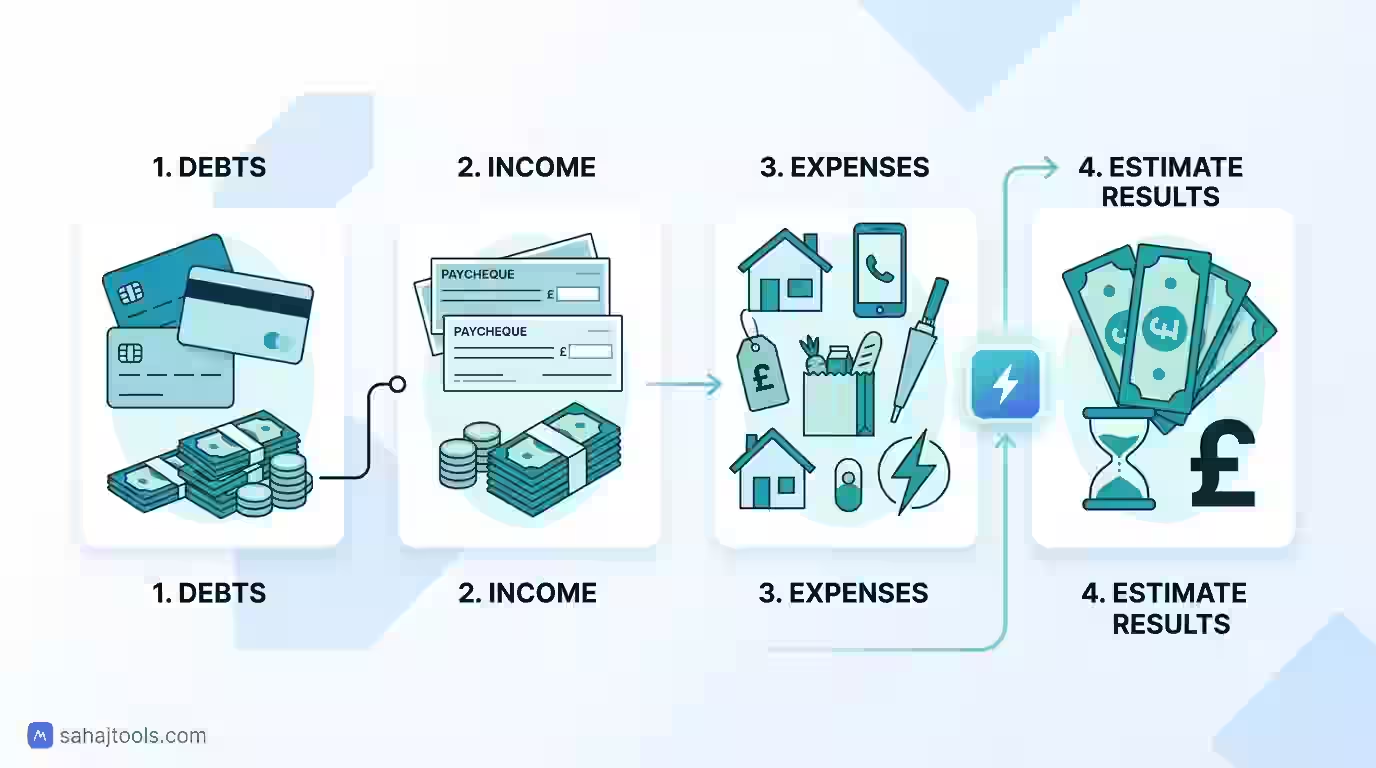
Whether you think of it as an IVA payment calculator or an IVA repayment calculator, this free IVA calculator walks through four simple steps to build your estimate:
- Your Debts — enter your total unsecured debt, the number of creditors, and your home ownership status.
- Income — add up your monthly take-home pay, benefits or tax credits, pension income, and any other income.
- Expenses — enter your essential monthly living costs, such as rent or mortgage, utilities, food, transport, and childcare.
- Results — the calculator works out your disposable income and turns that into an estimated monthly IVA payment, contribution term, and potential debt write-off.
Because this is a free IVA calculator built for quick, private exploration, you don’t need to speak to anyone or share personal details to get a first look at the numbers.
How Monthly IVA Payments Are Calculated (IVA Monthly Payment Calculator Logic)
Your estimated IVA monthly payment is based on one core idea: monthly disposable income, which is what’s left of your income after essential expenses are covered. In practice:
Monthly Disposable Income = Total Monthly Income − Total Monthly Essential Expenses
Getting this calculation right matters: it directly determines what counts as affordable repayments in your proposal. Whatever is left over each month is treated as your available monthly surplus income, and this — not your total debt — is what typically sets your monthly contribution. Essential expenses in an IVA affordability check are assessed against Standard Financial Statement (SFS) guidelines, meaning only reasonable, justifiable living costs are accepted. Insolvency practitioners look closely at categories like rent or mortgage, council tax, utilities, food and groceries, transport, phone and internet, childcare, insurance, and medical costs — anything beyond a reasonable amount for these categories may be challenged or reduced during a real assessment.
This is why two people with identical debt levels can end up with very different monthly IVA contributions: the number is driven by what’s actually left over each month, not by the size of the debt itself.
Debts That Can and Cannot Be Included
An IVA is built specifically for unsecured debt, which is why this works as an IVA for unsecured debts calculator rather than a secured-lending tool. That typically includes:
- Credit cards and store cards
- Personal loans
- Overdrafts
- Catalogue and mail-order debts
- HMRC tax arrears (in many cases)
It does not cover secured debt, such as your mortgage or a car on hire purchase, since these are tied to an asset the lender can repossess if payments stop. Student loans and certain court fines are also generally excluded. If your debt is a mix of secured and unsecured borrowing, only the unsecured portion is typically factored into an IVA proposal.
Eligibility: Do You Qualify for an IVA? (IVA Qualification Criteria)
If you have ever asked “am I eligible for an IVA,” this is where an IVA eligibility calculator earns its keep. IVA eligibility isn’t based on a single number — it’s a combination of factors an insolvency practitioner reviews together. The main criteria include:
- Unsecured debt level — IVAs are generally considered suitable for total unsecured debt of £5,000 or more, though there’s no fixed lower limit written in law.
- Number of creditors — most IVAs work best with two or more separate unsecured creditors, since the arrangement depends on a creditor vote. A single-creditor situation can still be assessed, but it’s less straightforward and may need a different debt solution.
- Disposable income — you need enough monthly surplus income after essential expenses to make a consistent, affordable contribution over the IVA term.
- Home ownership status — homeowners are usually still eligible, but if you have significant equity in your property, you may be asked to release some of it partway through the arrangement, or the IVA term may be extended toward six years instead of the standard five. In practice this means an IVA term 5 years arrangement is standard, while an IVA term 6 years arrangement applies mainly to homeowners with property equity.
None of these factors work in isolation, and if your proposal is later adjusted, it typically happens through debt restructuring of the original terms rather than a rejection outright. A large debt with strong disposable income might still be turned down if there’s only one creditor, while a smaller debt with tight finances might not generate enough of a contribution to make an IVA worthwhile compared with other options.
Worked Example: IVA Repayment Estimate (IVA Payment Estimate)
If you’re wondering “how much will my IVA payment be,” here’s how the numbers might work for someone with mid-range unsecured debt and steady income:
Item | Amount |
Total unsecured debt | £25,000 |
Total monthly income | £2,650 |
Total monthly essential expenses | £1,250 |
Monthly disposable income | £1,400 |
IVA term | 60 months (5 years) |
Monthly IVA payment | £1,400 |
Gross contributions over the term | £84,000 |
Insolvency practitioner fees (nominee, supervisor, disbursements) | ~£15,000 |
Net amount to creditors | ~£69,000 |
In this scenario, the monthly contribution is high relative to the debt, and — notably — this example only lists a single creditor, which is below the two-or-more creditors most IVAs require for standard approval. That combination would typically flag the case as “potentially eligible, but with caution,” meaning speaking to a licensed insolvency practitioner is essential before assuming any figures are final. It’s a useful reminder that a strong disposable income alone doesn’t guarantee straightforward eligibility.
How Much Debt Could Be Written Off? (Using an IVA Debt Write Off Calculator)
An IVA debt calculator like this one exists precisely to answer that question. The estimated debt write off is simply the gap between your total unsecured debt and the total amount you’re projected to repay (including insolvency practitioner fees) over the IVA term. If your gross contributions plus fees are close to or exceed your total debt, as in a case with high disposable income and moderate debt, the estimated write-off can be minimal or even zero — the IVA still helps by freezing interest and consolidating payments, but it may not deliver much debt forgiveness. Conversely, someone with a larger debt balance and a modest, sustainable monthly contribution over five years often sees more IVA write off debt at the end. This is why running your own numbers through an IVA calculator before assuming a particular outcome is so useful — the write-off percentage varies significantly from case to case.
IVA Versus Bankruptcy and IVA Versus Debt Management Plan
Feature | IVA | Bankruptcy | Debt Management Plan (DMP) |
Legally binding | Yes, once approved by creditor vote | Yes | No, informal arrangement |
Debt write-off | Often partial, after term ends | Most unsecured debt discharged | Rarely, debt repaid in full |
Typical duration | 5–6 years | Usually 12 months to discharge | Flexible, until debt is repaid |
Keeps your home | Usually, subject to equity terms | Often at risk, especially with equity | Yes |
Impact on credit file | Recorded for 6 years | Recorded for 6 years | Recorded while active |
Protects from creditor contact | Yes, once in place | Yes | Not legally guaranteed |
Weighing IVA versus bankruptcy and IVA versus debt management plan side by side, an IVA sits between the two: it offers a structured, legally binding route to some debt write-off without the asset risk that often comes with bankruptcy, but it demands more formal commitment than an informal debt repayment plan like a DMP. For many people comparing debt relief options, this middle ground is exactly why an IVA is worth considering as a genuine debt solution.
Common Mistakes to Avoid
- Underestimating essential expenses — entering unrealistically low living costs can make your estimated disposable income look higher than what an insolvency practitioner would actually approve.
- Assuming debt level alone determines eligibility — the number of creditors and your disposable income matter just as much as your total unsecured debt.
- Forgetting insolvency practitioner fees — nominee, supervisor, and disbursement fees are deducted from your contributions before creditors receive anything, which directly affects the real write-off percentage.
- Treating the estimate as final — every IVA proposal is reviewed and can be adjusted by creditors or your insolvency practitioner; the calculator gives you a starting point, not a guarantee.
Frequently Asked Questions
An Individual Voluntary Arrangement is a formal, legally binding agreement to repay a portion of your unsecured debt over a set period, typically five years, supervised by a licensed insolvency practitioner and approved by your creditors.
It takes your total unsecured debt, income, and essential expenses, works out your monthly disposable income, and uses that figure to estimate your likely monthly IVA payment, contribution term, and potential debt write-off.
It varies by case. The write-off is the difference between your total debt and what you're projected to repay (including fees) over the term — this can range from a small percentage to a substantial portion of the debt, depending on your disposable income relative to your total balance.
Generally, you need unsecured debt of around £5,000 or more, at least two separate creditors, and enough disposable income after essential expenses to make a consistent monthly contribution.
Your monthly payment is typically based on your disposable income — total monthly income minus reasonable essential living expenses — rather than being a fixed percentage of your total debt.
Essential costs such as rent or mortgage, council tax, utilities, food, transport, phone and internet, childcare, insurance, and medical costs are assessed against Standard Financial Statement guidelines to determine what's reasonable.
Most IVAs run for five years, though homeowners with equity in their property may see the term extended to six years as part of the arrangement.
Unsecured debts such as credit cards, personal loans, overdrafts, catalogue debts, and HMRC arrears can typically be included; secured debts like mortgages are not.
An IVA is a structured repayment agreement that usually lets you keep your home and assets, while bankruptcy can put assets at greater risk but generally clears unsecured debt faster.
If creditors don't approve the proposal through the creditor vote, you'd need to explore other debt solutions, such as a debt management plan, bankruptcy, or a revised IVA proposal with adjusted terms.
A Note Before You Rely on These Numbers
As an Individual Voluntary Arrangement calculator, this tool provides estimates only, based on general IVA guidance and typical repayment structures — it is not financial, legal, or debt advice, and it isn’t a substitute for a full assessment. Actual IVA payments, eligibility, and write-off amounts are determined by a licensed insolvency practitioner after reviewing your complete financial circumstances. If you’re dealing with debt and considering an IVA, speaking to a licensed insolvency practitioner or a free debt advice service is the right next step before making any decisions. IVAs are available to residents of England, Wales, and Northern Ireland; if you’re in Scotland, ask about a Protected Trust Deed instead.
Ready to See Your Numbers?
An IVA calculator won’t replace a conversation with a licensed insolvency practitioner, but it gives you something valuable before that conversation even happens: a realistic sense of your IVA monthly repayments, IVA term, and potential debt write-off. Whether you’re comparing an IVA against a debt management plan or just trying to understand where you stand, running your figures through the calculator above is a solid first step toward a clearer picture of your debt solution options.
Last Update: August 2026