
Table of Contents
ToggleJEPQ Dividend Calculator: Estimate Your Monthly Income
If you’re holding or considering JPMorgan Nasdaq Equity Premium Income ETF (JEPQ) shares, the JEPQ dividend calculator helps you translate an investment amount, share price, and yield into a concrete monthly income estimate. Rather than guessing what your position might pay out, this tool lets you model realistic scenarios — with or without dividend reinvestment — so you can see how your income and share count evolve over time.
JEPQ has become one of the more closely watched income ETFs on the market because of its monthly payout schedule and its use of a covered call strategy against the Nasdaq-100. That structure produces a distinctive income profile, and this calculator is built specifically to reflect it.
JPMorgan Nasdaq Equity Premium Income ETF
JEPQ Dividend Calculator
Accurate monthly dividend projections with DRIP reinvestment simulation & compound growth analysis
~10.5% Annual Yield
Monthly Payouts
0.35% Expense Ratio
Investment Parameters
$
#
$
Current market price · Last: $58.95
%
TTM yield ≈ 10.47% · Forward yield ≈ 10.5%
yrs
mos
%
Historical avg capital appreciation (optional)
%
Set 0 to ignore tax impact
$
DCA — dollar cost average each month
DRIP — Dividend Reinvestment Plan
Automatically reinvest monthly dividends to purchase additional shares, compounding your returns over time.
Projection Results
Total Dividends Earned
—
Final Portfolio Value
—
Total Shares Owned
—
Monthly Income (Final)
—
Initial Investment
—
Total Contributions
—
Dividend Income (Net)
—
Capital Gain/Loss
—
Total Return
—
Annualized Return (CAGR)
—
Portfolio Growth Over Time
Portfolio ValueCumulative DividendsTotal Invested
Year-by-Year Breakdown
| Year | Shares | Share Price | Annual Dividend | Cumul. Dividends | Portfolio Value |
|---|
⚠ For educational & informational purposes only. Past dividends do not guarantee future payouts. JEPQ dividends vary monthly based on covered call premiums and market conditions. Consult a financial advisor before investing.
Reset Calculator?
This will clear all inputs, results, and saved session data. This action cannot be undone.
✓ Copied to clipboard!
related finance & business calculators
What Is JEPQ and How Does Its Dividend Work?
JEPQ, the JPMorgan Nasdaq Equity Premium Income ETF, is a covered call fund that holds a portfolio linked to the Nasdaq-100 and layers an options-selling strategy on top. Instead of paying dividends quarterly like most traditional equity funds, JEPQ distributes income to shareholders every month. That monthly distribution is drawn from a combination of dividend income on the underlying holdings and premium income collected from writing call options.
This matters for how you should think about the “dividend.” Unlike a conventional dividend-paying stock, JEPQ’s monthly payout is better described as a distribution, since a portion of it can come from options premium rather than pure company earnings. The amount paid each month isn’t fixed — it moves with market volatility, the value of the underlying Nasdaq-100 basket, and the premiums available in the options market at the time. That’s precisely why a forward-looking estimate, rather than a single static number, is the most useful way to plan around JEPQ dividend income.
How the JEPQ Dividend Calculator Works
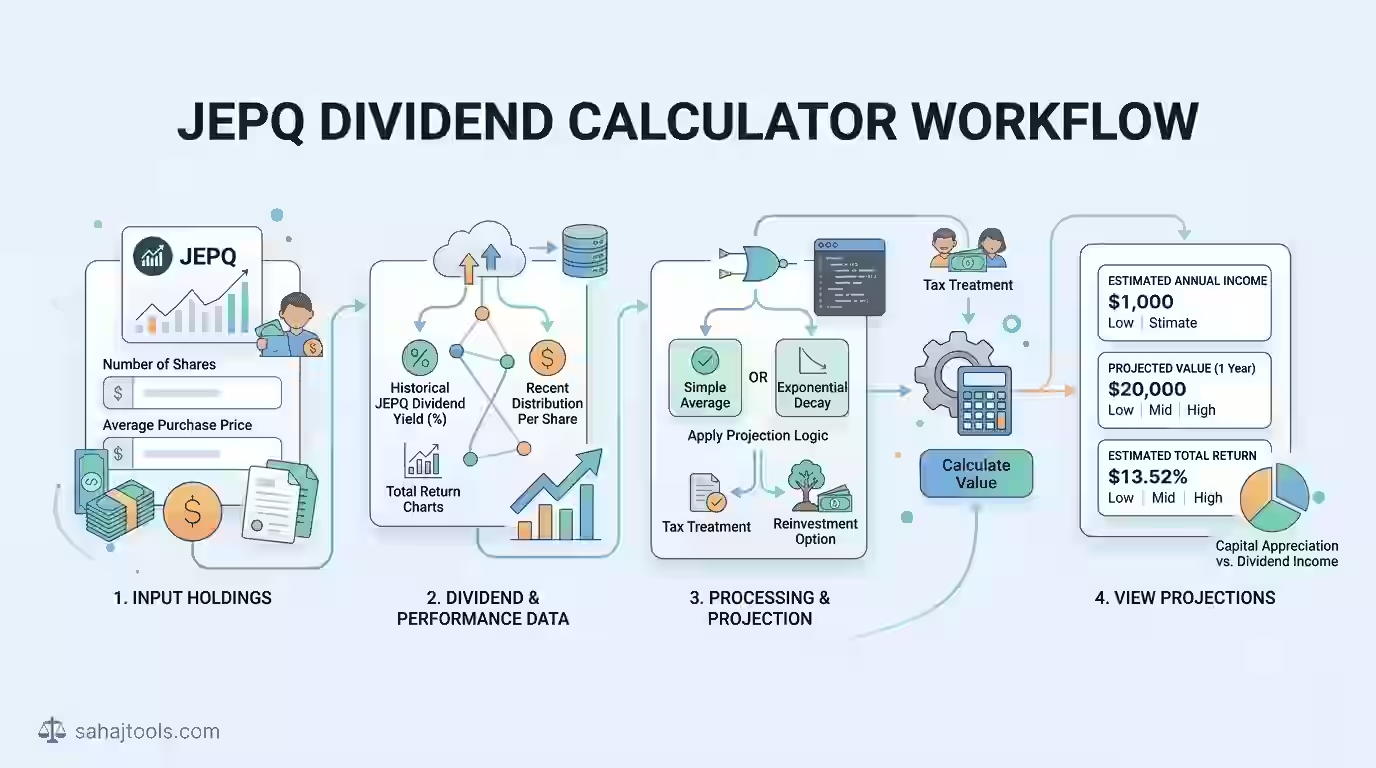
The calculator’s core logic is straightforward, even though the underlying fund mechanics are more complex. It starts from your investment amount (or number of shares) and share price to determine how many shares you own. From there, it applies your annual dividend yield input to estimate the annualized dividend per share, then divides that by JEPQ’s monthly payout frequency to project a monthly distribution figure.
The formula in plain terms:
- Shares owned = Investment amount ÷ Share price (or entered directly)
- Annual dividend income = Shares owned × Share price × Annual dividend yield
- Monthly dividend income = Annual dividend income ÷ 12
- DRIP effect (if enabled) = Each month’s dividend buys additional shares at the current share price, increasing next month’s share count and, in turn, next month’s payout
Because JEPQ’s actual distribution varies month to month, the calculator uses your entered yield — whether that’s the trailing twelve months (TTM) yield or the current forward yield — as a modeling assumption rather than a guarantee. If you also enter an annual share price growth rate, the tool factors in compounding capital appreciation alongside dividend compounding, giving you a fuller total return picture rather than income alone.
How to Use This Calculator
Using the tool takes just a few inputs:
- Choose your input method — enter either your total investment amount or the exact number of shares you hold or plan to buy.
- Enter the share price — use JEPQ’s current market price, or a hypothetical entry price if you’re planning a future purchase.
- Enter the annual dividend yield — you can use JEPQ’s TTM yield for a historically grounded estimate, or its forward yield for a more current projection.
- Set your investment duration — in years and months, depending on how far out you want to project.
- Optionally add annual share price growth — a modest assumption based on historical capital appreciation, if you want to model total return rather than income alone.
- Optionally set a dividend tax rate — to see an after-tax income projection instead of a gross figure.
- Add a monthly additional investment — if you plan to dollar-cost average into JEPQ over time.
- Toggle DRIP on or off — to compare reinvesting every dividend into additional shares versus taking the cash distribution.
Once you hit calculate, the tool projects your monthly and annual dividend income, your ending share count, and your estimated portfolio value at the end of your chosen time horizon.
Worked Example: JEPQ Dividend Income Projection
Here’s how the numbers play out for a sample investor putting $50,000 into JEPQ at a $58.95 share price with a 10.5% annual dividend yield, held for one year with DRIP enabled.
Metric | Value |
Investment amount | $50,000 |
Share price | $58.95 |
Shares purchased | 848.2 |
Annual dividend yield | 10.5% |
Estimated annual dividend income | $5,250 |
Estimated monthly dividend income (Month 1) | $437.50 |
Shares added via DRIP (Month 1) | 7.42 |
Estimated dividend income (Month 12, with DRIP) | ~$462 |
Estimated ending share count (after 12 months, DRIP on) | ~893 |
This example illustrates the core value of dividend reinvestment: because each monthly distribution buys additional shares, the following month’s payout is calculated on a slightly larger share base. Over a single year the effect is modest, but the compounding accelerates meaningfully across a five- or ten-year holding period — which is exactly why the calculator lets you extend the investment duration well beyond 12 months.
DRIP vs. Cash Dividends: Which Should You Model?
Enabling DRIP (Dividend Reinvestment Plan) means every monthly distribution automatically purchases additional JEPQ shares at the prevailing price rather than being paid out as cash. Turning DRIP off means you receive the dividend as cash income each month, and your share count stays fixed unless you separately buy more shares.
The difference isn’t just theoretical:
- With DRIP enabled, your share count grows every month, so your dividend income compounds — this month’s payout is always calculated on a larger position than last month’s.
- With DRIP disabled, your share count stays flat (aside from any monthly additional investment you specify), and your dividend income tracks the yield and share price alone, without reinvestment-driven growth.
Neither approach is objectively better — it depends on whether you need the monthly cash flow now or you’re building a position for future income. Many investors model both scenarios side by side using the calculator’s toggle to decide which fits their stage of investing.
JEPQ Dividend History, Yield Metrics, and Payout Frequency
JEPQ pays dividends monthly, which is one of its defining features relative to many traditional dividend ETFs. Each distribution follows a standard sequence: an ex-dividend date (the cutoff to be eligible for that month’s payout), a record date, and a payment date when the cash actually lands in your account.
Because the fund’s distributions vary month to month based on options premium income and market conditions, JEPQ’s dividend history shows a range of monthly figures rather than one flat repeating number. Two yield figures are commonly used to summarize that history:
- TTM yield (trailing twelve months) — the sum of the last 12 months of actual distributions divided by the current share price. This reflects realized, historical payout performance.
- Forward yield — an annualized projection based on the most recent monthly distribution, multiplied by 12. This is more sensitive to a single recent data point and can shift quickly if that month’s payout was unusually high or low.
When using the calculator, choosing between TTM and forward yield changes your projection meaningfully, so it’s worth running both to see the range of plausible outcomes rather than anchoring to a single figure.
Modeling Taxes on JEPQ Dividend Income
Because a portion of JEPQ’s monthly distributions can be treated differently for tax purposes than qualified dividends from traditional stocks, after-tax income can look noticeably different from the gross figure the calculator shows by default. The calculator includes an optional dividend tax rate field so you can model an after-tax income estimate rather than only the gross projection.
Tax treatment of ETF distributions depends on your individual tax situation, the composition of the distribution (ordinary income, qualified dividends, or return of capital can each apply differently), and your jurisdiction. Because this varies by investor, the calculator’s tax field is a modeling estimate only — for the exact tax treatment of your JEPQ distributions, consult your fund’s official distribution characterization documents or a tax professional.
Common Mistakes When Estimating JEPQ Dividend Income
A few habits lead investors to over- or underestimate what they’ll actually receive:
- Treating the most recent monthly distribution as a fixed, repeating number. JEPQ’s covered call strategy means payouts fluctuate with market volatility and options premiums — plan around a range, not a single fixed figure.
- Confusing forward yield with a guaranteed rate. Forward yield annualizes one recent data point; it’s a projection, not a promise.
- Ignoring the tax treatment of distributions. Skipping the tax field can significantly overstate your realistic take-home income.
- Assuming DRIP share purchases happen at a fixed price. In reality, reinvestment occurs at whatever the share price is on the payment date, which the calculator approximates using your growth rate assumption.
- Overlooking share price movement entirely. A high dividend yield doesn’t guarantee a positive total return if the share price declines — this is why the calculator’s optional share price growth field matters for a complete picture.
Important Disclaimer
This calculator is provided for educational and informational purposes only and does not constitute investment advice. It generates estimates based on the yield, price, and assumptions you enter — not a guarantee of future performance. Past JEPQ distributions do not guarantee future payouts, and monthly income can rise or fall based on market conditions and options premium levels.
JEPQ is a high-yield, covered-call ETF, and funds in this category carry risks that differ from traditional dividend-paying stocks, including the potential for distributions to include return of capital and for share price appreciation to be capped relative to the underlying index during strong up markets. Before making investment decisions, verify current yield, distribution history, and fund characteristics directly through JPMorgan’s official fund documentation or a licensed financial advisor.
Frequently Asked Questions
Monthly income depends on your investment amount, JEPQ's share price, and the yield you use in your estimate. Using a 10.5% annual yield on a $50,000 investment, for example, projects to roughly $437 in the first month, before accounting for DRIP compounding or share price changes.
Annual income is your monthly estimate multiplied by 12, adjusted for any DRIP-driven share growth or additional monthly investments throughout the year. The calculator totals this automatically across your chosen time horizon.
JEPQ's yield fluctuates monthly based on options premium income and market volatility. Check the fund's current TTM and forward yield figures directly through JPMorgan's official site or your brokerage before finalizing any projection.
Enabling DRIP reinvests each monthly distribution into additional shares, so future payouts are calculated on a growing share base. The compounding effect is small in any single month but becomes substantial over multi-year holding periods.
JEPQ distributes dividends monthly, following an ex-dividend date, record date, and payment date each cycle, rather than the quarterly schedule common among traditional dividend stocks.
Ex-dividend dates change monthly and are set by the fund. Confirm the current schedule through JPMorgan's official JEPQ distribution calendar or your brokerage platform, since this calculator does not track live dates.
Divide your investment amount by the current share price. The calculator does this automatically when you select "By Investment Amount" and enter your total.
Cash dividends are paid out to you directly each month, leaving your share count unchanged. DRIP automatically uses that cash to buy additional JEPQ shares, growing your position and future dividend income over time.
Because JEPQ distributions can include a mix of ordinary income, qualified dividends, and return of capital, your after-tax income may differ from the gross projection. Use the calculator's tax rate field to model an after-tax estimate, and confirm exact treatment with a tax professional.
Annual dividend per share is the sum of the fund's monthly distributions per share over a 12-month period. Since distributions vary, this figure is best estimated using either TTM yield or an annualized forward yield.
Total return combines dividend income (with or without DRIP) and any share price appreciation or decline. Enter an annual share price growth assumption alongside your yield to see a combined total return estimate rather than income alone.
Yes. JEPQ is structured to pay distributions monthly rather than quarterly, which is one of the main reasons income-focused investors use it for building predictable, if variable, monthly cash flow.
The JEPQ dividend calculator gives you a practical way to turn share price, yield, and time horizon into a concrete monthly income picture — with the flexibility to compare DRIP reinvestment against cash payouts, factor in taxes, and account for dollar-cost averaging. Because JEPQ’s actual monthly distributions move with market conditions, treat every projection as an estimate to revisit periodically rather than a fixed number to plan your entire budget around. If you’re evaluating JEPQ alongside other income-focused holdings, a general dividend yield or portfolio income tracking tool can help you compare how different positions contribute to your overall monthly cash flow.
Last Update: August 2026