
Table of Contents
ToggleMonthly Savings Calculator: Reach Your Savings Goal Faster
Our free monthly savings calculator shows you exactly how much to save each month to hit any financial target — whether you’re building an emergency fund, saving for a home, or planning a major purchase. Enter your goal, timeline, and interest rate to get a projected savings balance in seconds.
Savings Calculator
Plan smarter. Save better.
Your Savings Plan
Fill in the details below to calculate your future savings.
Your results will appear here
Enter your savings details and click Calculate Savings to see a full breakdown.
Savings Projection
Over 0 years
Total Future Value$0.00
💵Total Contributions$0.00
📈Interest Earned$0.00
🏦Initial Deposit$0.00
🔢Effective APY0.00%
Contribution Breakdown
InitialContributionsInterest
Year-by-Year Breakdown
| Year | Balance | Contributions | Interest |
|---|
ℹ️
⚠️
Reset Calculator?This will clear all inputs and results. This action cannot be undone.
related finance & business calculators
What Is a Monthly Savings Calculator?
A monthly savings calculator is a financial goal calculator that projects how your savings balance will grow over time based on your starting amount, regular monthly deposits, interest rate, and savings timeline. It works as both a savings goal calculator — showing whether your current contributions are on track — and a savings target calculator — telling you the required monthly savings needed to hit a specific future value.
Unlike a simple bank savings calculator that only shows interest on a lump sum, this tool accounts for regular deposit savings made every month, compounding interest earned on both the initial investment and every new contribution, and an optional inflation adjustment to show your money’s real purchasing power over time.
Anyone saving for a goal — a vacation, a down payment, an emergency fund, or retirement — can use it to build a realistic, numbers-backed monthly savings plan.
How the Monthly Savings Calculator Works
The calculator uses future value of an annuity mathematics, the same formula banks and financial planners use to model compound savings growth. Here is what it calculates:
Future Value = (Initial Savings × (1 + r)^n) + Monthly Deposit × [((1 + r)^n − 1) / r]
Where r is the periodic interest rate (annual interest rate ÷ compound frequency) and n is the total number of compounding periods.
What each input does:
- Initial Savings is your starting balance. This can be zero if you are starting from scratch — or any existing amount already sitting in your account.
- Monthly Deposit is the fixed monthly contribution amount you plan to add each month. This is the most powerful lever in the formula: increasing your monthly deposit by even a small amount has a large effect on the final savings amount over a long timeline.
- Annual Interest Rate (APY) is the annual percentage yield offered by your savings account or investment vehicle. Most high-yield savings accounts currently offer between 4% and 5% APY in the US, though rates change frequently.
- Compound Frequency controls how often interest is calculated and added to your balance. Monthly compounding (12×/year) is the most common for savings accounts. More frequent compounding means marginally more interest earned over time.
- Savings Period is the total time you plan to save, entered in years and months. The longer the period, the more compound interest contributes to your savings growth.
- Adjust for Inflation is an optional toggle. When enabled, the calculator applies the expected inflation rate (defaulting to 3% per year, the US historical average) to express your future savings value in today’s purchasing-power terms. This is useful for longer-term goals where a projected savings value ten years from now will feel smaller than it looks today.
- Currency lets you switch the display symbol if you are saving in a currency other than US dollars.
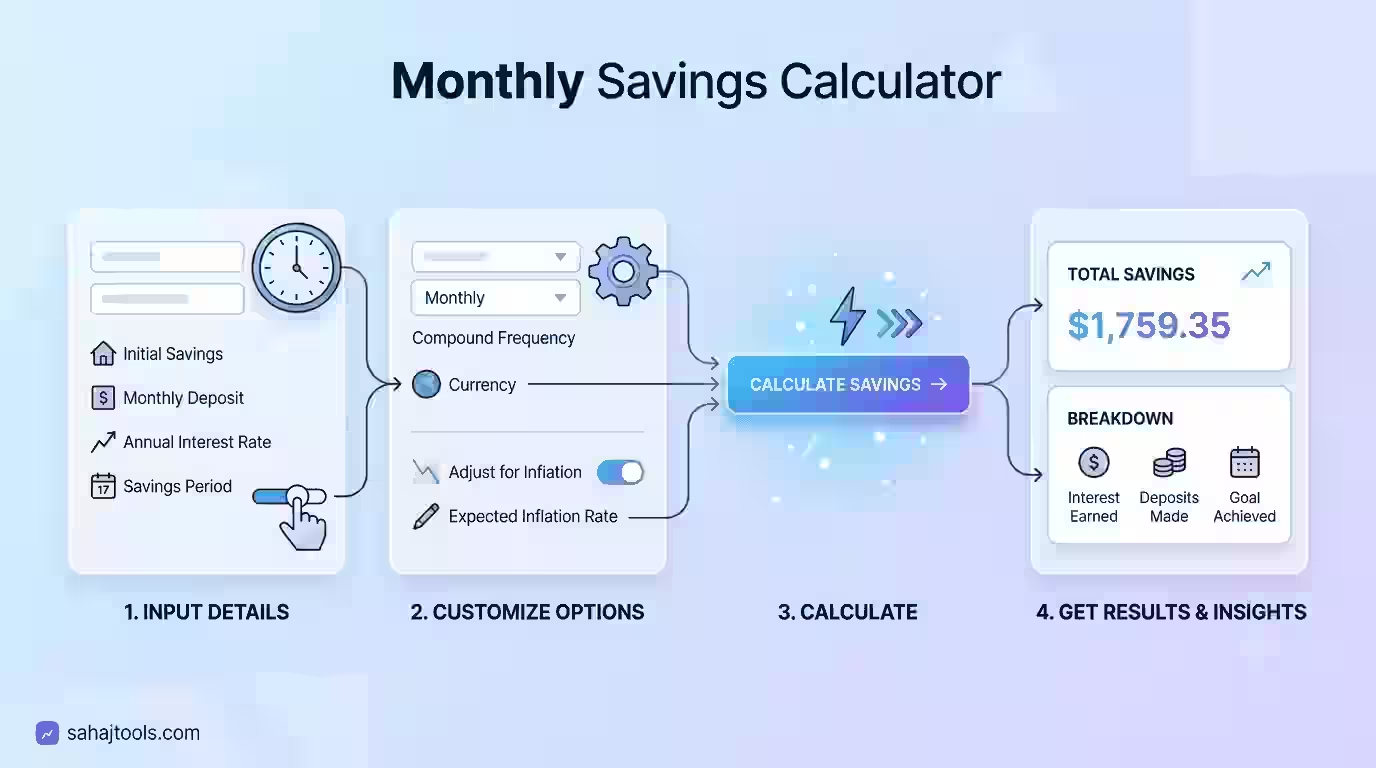
How to Use the Monthly Savings Calculator — Step by Step
The calculator interface has two panels: a form on the left where you enter your savings details, and a results panel on the right that displays your projected savings breakdown after you click Calculate Savings.
- Step 1 — Enter your Initial Savings. Type in your current starting balance. If you have nothing saved yet, leave it at $0.00.
- Step 2 — Enter your Monthly Deposit. This is the fixed monthly contribution amount you plan to add each month. Be realistic here — use an amount you can consistently sustain.
- Step 3 — Enter your Annual Interest Rate. Check your savings account’s current APY. If you are modeling a goal without a specific account in mind, 4.5% is a reasonable benchmark for US high-yield savings accounts as of 2025.
- Step 4 — Choose your Compound Frequency. Monthly (12×/year) is pre-selected and correct for most savings accounts. Change this if your account compounds differently.
- Step 5 — Set your Savings Period. Enter the number of years and months you plan to save. For a 3-year goal, enter 3 years and 0 months.
- Step 6 — Toggle Adjust for Inflation if you want the result in real (today’s) dollars rather than nominal future dollars. The Expected Inflation Rate field will appear, pre-filled at 3.00% — you can adjust this.
- Step 7 — Select your Currency if you want the output displayed in a currency other than USD.
- Step 8 — Click Calculate Savings. Your results will appear in the right panel with a full breakdown: projected savings balance, total contributions, total interest earned, and — if inflation is on — the inflation-adjusted value.
Worked Example — Saving for a Home Down Payment
Say you want to save $30,000 for a home down payment in 4 years. You currently have $2,000 in savings and expect your high-yield account to earn 4.8% APY, compounded monthly.
Entering these values into the calculator:
- Initial Savings: $2,000
- Monthly Deposit: $550
- Annual Interest Rate: 4.8%
- Compound Frequency: Monthly
- Savings Period: 4 years, 0 months
- Inflation adjustment: off
Projected result after 4 years:
- Total contributions: $28,400 (your $2,000 start plus 48 × $550)
- Total interest earned: approximately $2,850
- Final savings amount: approximately $31,250
You would reach your $30,000 savings target roughly 2 months ahead of schedule, with about $1,250 in interest earned on top of your own deposits. That is the compounding effect of regular deposit savings working for you.
If you toggle the inflation adjustment on at 3%/year, the calculator would show that $31,250 in 4 years is worth roughly $27,750 in today’s purchasing power — useful context if you are saving for something whose price is also likely to rise over time.
Practical Tips for Building a Monthly Savings Plan
- Automate your monthly deposit amount. Set up an automatic transfer on payday so your savings contribution happens before you can spend it. Automation is the single most reliable way to hit a savings timeline calculator target.
- Use the calculator in reverse. If you already know your savings goal and deadline, adjust the monthly deposit field until the projected balance matches your target. This tells you the required monthly savings needed — and whether it fits your budget.
- Factor in savings account growth realistically. APY rates on savings accounts change. If you are planning a multi-year savings goal, run the numbers at both your current APY and a more conservative 2–3% to understand the range of outcomes.
- Revisit your plan quarterly. Deposit a windfall (tax refund, bonus) directly into savings and recalculate. Even one extra contribution can meaningfully shorten your time to reach your savings goal.
- Do not ignore inflation for long-term goals. For any target more than 3–5 years away, the inflation adjustment toggle shows you whether your projected savings value will still cover what you are planning to buy.
other financial & banking calculators
- Savings Goal Calculator: Determine how much you need to save monthly to reach a specific target (e.g., a down payment).
- Compound Interest Calculator: Compare how different interest rates and compounding frequencies affect your savings.
- Emergency Fund Calculator: Calculate how much to set aside for unexpected expenses.
- Budget Planner Calculator: Manage your income and expenses to free up more for savings.
- Net Worth Calculator: Track your overall financial health alongside your savings growth.
Frequently Asked Questions
Enter your savings goal as the target in the calculator, then adjust the Monthly Deposit field until the projected final savings amount matches your target. The calculator will show you the exact required monthly savings for your chosen timeline and interest rate.
Adjust the Savings Period field while keeping your other inputs fixed. Increase the period until the projected balance meets your goal — that gives you your minimum savings timeline. Alternatively, increase your monthly deposit to hit the target sooner.
Compound interest means you earn interest not just on your deposits but on the interest already accumulated. With monthly compounding, each month's balance — including all previous interest earned — earns new interest. Over time, this accelerates your savings growth significantly compared to simple interest, especially with a longer savings period.
Financial planners typically recommend 3–6 months of living expenses as an emergency fund target. Enter that dollar amount as your goal, set a realistic savings period (6–24 months is common), add your current APY, and the calculator will show the required monthly contribution.
The annual interest rate is the stated rate before compounding is applied. APY (annual percentage yield) is the effective yearly rate after compounding is factored in — it is always equal to or higher than the annual interest rate. Compound frequency controls how often interest is added to your balance; monthly compounding is standard for savings accounts. When using this calculator, enter the APY if your account quotes it, or enter the annual interest rate and set the compound frequency to match your account terms.
Inflation reduces purchasing power over time, which is why the calculator's inflation adjustment toggle converts your future nominal savings value into real (today's dollar equivalent) terms. Taxes are not modeled in this calculator because tax treatment of savings interest varies by account type — interest in a regular savings account is taxable; interest in a Roth IRA or HSA may not be. For tax-specific scenarios, consult a tax professional or use a dedicated retirement savings calculator.
Disclaimer
This monthly savings calculator is provided for educational and planning purposes only. Results are estimates based on the inputs you provide and assume a fixed monthly deposit, a constant interest rate, and uninterrupted compounding for the entire savings period. Actual savings account growth will vary based on rate changes, missed contributions, fees, and other factors. This tool does not constitute financial advice. For personalized guidance, consult a licensed financial advisor.
Last Update: June 2026