
Table of Contents
ToggleMortgage Calculator WV — Estimate Your Monthly Payment Instantly
The West Virginia mortgage calculator estimates your full monthly payment — principal, interest, property taxes, insurance, and PMI — in seconds. Enter your home price, down payment, loan term, and interest rate to see a complete PITI breakdown and understand exactly what you’ll owe each month before you commit to a loan.
West Virginia
Mortgage Calculator WV
Accurate monthly payment estimates with WV property taxes, insurance & PMI
Loan Details
$
$%
PMI applies when down payment < 20%
%
Additional Costs
%
WV avg: 0.53%
$
Annual cost
%
If down < 20%
$
Monthly (optional)
Your estimate will appear here
Fill in your loan details and click "Calculate Payment" to see your full monthly breakdown.
Estimated Monthly Payment
$0
Principal & Interest—
Property Tax—
Home Insurance—
PMI—
HOA—
Loan Amount
—
Total Interest
—
Total Payment
—
Payoff Date
—
Amortization Schedule
| Year | Principal | Interest | Balance |
|---|
This calculator provides estimates for informational purposes only. Results are based on the information you provide and current West Virginia average property tax rates (0.53%). Consult a licensed mortgage professional for personalized advice.
Reset Calculator?
This will clear all inputs and results. This action cannot be undone.
related finance & business calculators
What Is a West Virginia Mortgage Calculator?
A West Virginia mortgage calculator is an online tool that estimates your monthly home loan payment using the specific financial and tax conditions that apply to WV homebuyers. Unlike generic mortgage calculators, a state-specific tool pre-loads West Virginia’s average property tax rate (0.53%) and lets you factor in homeowner’s insurance, PMI, and HOA fees so your estimate reflects the true cost of homeownership in the Mountain State.
The calculator is built around the standard amortization formula used by virtually every mortgage lender in the United States. It breaks your monthly payment into four components — often called PITI:
- Principal — the portion of your payment that reduces your loan balance
- Interest — the cost charged by the lender for borrowing the money
- Taxes — your monthly share of annual WV property taxes, held in escrow
- Insurance — homeowner’s insurance and, when applicable, private mortgage insurance (PMI)
Understanding all four components before you apply gives you a realistic picture of your housing budget and helps you compare loan options without surprises at closing.
How Is a West Virginia Mortgage Payment Calculated?
The Amortization Formula
Your principal and interest (P&I) payment is calculated using the standard fixed-rate amortization formula:
M = P × [r(1+r)^n] ÷ [(1+r)^n − 1]
Where:
- M = Monthly payment (principal + interest)
- P = Loan principal (home price minus down payment)
- r = Monthly interest rate (annual rate ÷ 12)
- n = Total number of payments (loan term in years × 12)
Your total monthly payment then adds the tax and insurance components on top:
Total Monthly Payment = M + Monthly Property Tax + Monthly Insurance + PMI (if applicable)
West Virginia Property Tax Rate
West Virginia has one of the lowest property tax rates in the United States. The statewide average effective rate is 0.53% of assessed value per year — significantly below the national average of approximately 1.10%. This lower tax burden meaningfully reduces the total monthly payment for WV homebuyers compared to buyers in higher-tax states.
Property tax rates do vary slightly by county. For example, Kanawha County (Charleston), Cabell County (Huntington), and Berkeley County (Martinsburg) each set their own millage rates, so your actual tax bill may differ modestly from the statewide default. The calculator uses 0.53% as the starting point; you can adjust it to reflect your specific county rate.
When Does PMI Apply?
Private mortgage insurance (PMI) is required by most conventional lenders when your down payment is less than 20% of the home’s purchase price. PMI protects the lender — not the borrower — against default risk. The calculator defaults to a PMI rate of 0.50% annually, which is a typical mid-range estimate. Your actual PMI rate depends on your credit score, loan-to-value ratio, and the lender’s pricing model. Once your equity reaches 20%, you can request PMI cancellation under the Homeowners Protection Act (PMI Act).
How to Use the Mortgage Calculator WV — Step-by-Step Guide
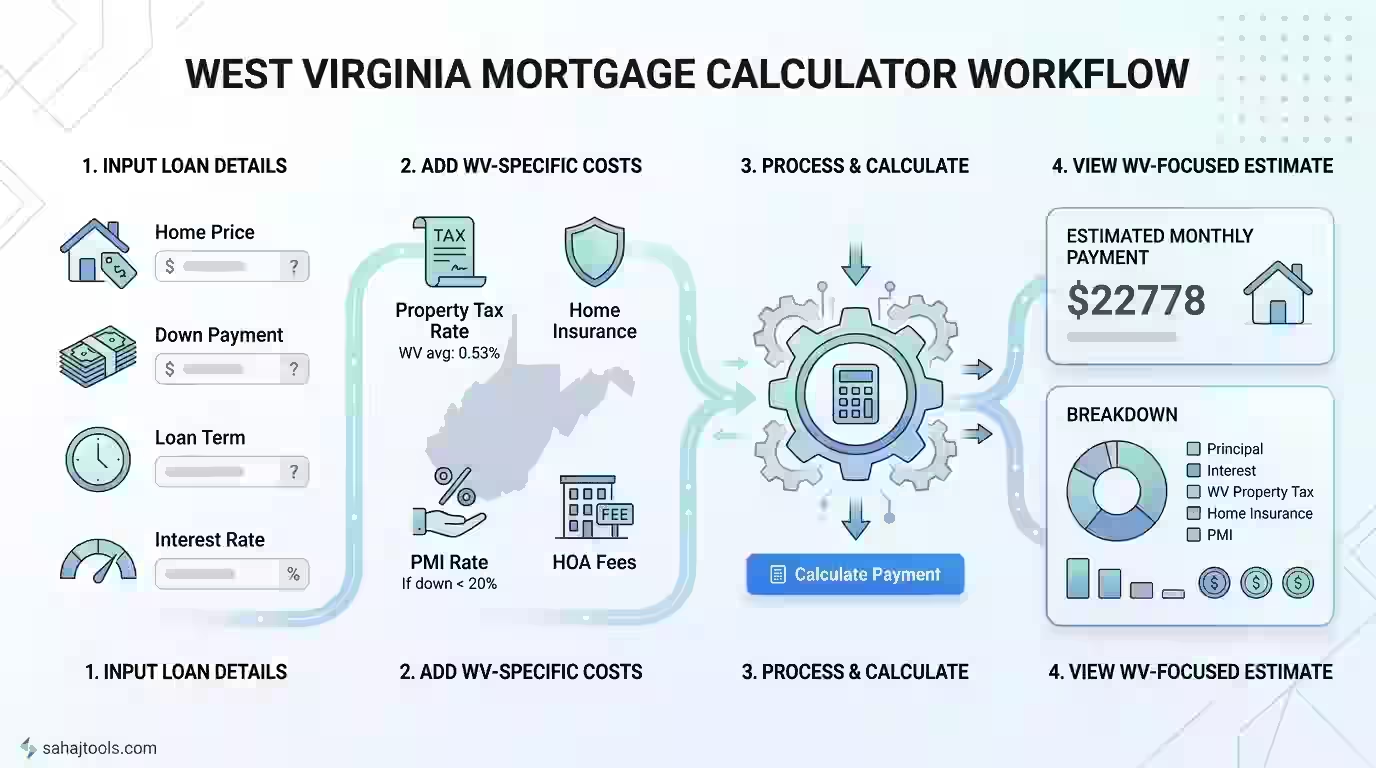
The calculator interface has two panels: Loan Details on the left, and your Payment Estimate on the right. Follow these steps:
- Enter your Home Price. Type the purchase price of the property in the “Home Price” field. The default is $300,000.
- Set your Down Payment. Enter either a dollar amount or a percentage. The two fields are linked — updating one automatically updates the other. The default is $60,000 (20%). A note below the field reminds you that PMI applies when your down payment falls below 20%.
- Select your Loan Term. Click one of the four term buttons — 30 yr, 20 yr, 15 yr, or 10 yr. The 30-year term is selected by default.
- Enter the Interest Rate. Type your expected or quoted annual interest rate as a percentage. The default placeholder (6.89%) reflects a typical benchmark — replace it with the rate your lender has quoted you for accuracy.
- Review Additional Costs. Under “Additional Costs,” confirm or adjust:
- Property Tax Rate — defaults to 0.53% (WV average). Update this if you know your county’s specific rate.
- Home Insurance — defaults to $1,200/year. Enter your actual annual premium if you have a quote.
- PMI Rate — defaults to 0.50%. Only applies when your down payment is below 20%.
- HOA Fees — optional monthly field for communities with homeowner association dues.
- Click “Calculate Payment.” Your full monthly PITI breakdown appears immediately in the right panel.
- Reset if needed. Use the Reset button to clear all fields and start a new estimate.
Worked Examples
Example 1 — First-Time Buyer, 30-Year Loan
A first-time buyer in Morgantown purchases a home priced at $250,000 with a 10% down payment ($25,000), a 6.89% interest rate, on a 30-year term. Property tax is the WV average of 0.53%, homeowner’s insurance is $1,200/year, and PMI applies at 0.50% because the down payment is below 20%.
Component | Monthly Amount |
Principal & Interest | $1,649 |
Property Tax (0.53%) | $110 |
Home Insurance | $100 |
PMI (0.50%) | $94 |
Total Monthly Payment | $1,953 |
Once the loan balance drops to 80% of the home’s value, the buyer can request PMI cancellation, reducing the monthly payment by roughly $94.
Example 2 — Established Buyer, 15-Year Loan, 20% Down
A buyer in Charleston purchases a home priced at $350,000 with a 20% down payment ($70,000), a 6.50% interest rate, on a 15-year term. No PMI applies. Insurance is $1,400/year.
Component | Monthly Amount |
Principal & Interest | $2,433 |
Property Tax (0.53%) | $154 |
Home Insurance | $117 |
PMI | $0 |
Total Monthly Payment | $2,704 |
The higher P&I payment versus a 30-year loan reflects the compressed repayment schedule, but the buyer saves significantly on total interest over the life of the loan — see the comparison section below.
Amortization Schedule Sample — $280,000 Loan at 6.89%, 30 Years
The table below shows representative rows from a full amortization schedule on a $280,000 principal balance.
Year | Beginning Balance | Annual Principal | Annual Interest | Ending Balance |
1 | $280,000 | $3,540 | $19,083 | $276,460 |
5 | $263,208 | $4,210 | $18,413 | $259,002 |
10 | $238,414 | $5,660 | $17,283 | $232,754 |
15 | $205,860 | $7,600 | $15,343 | $198,260 |
20 | $162,180 | $10,208 | $12,735 | $151,972 |
25 | $103,410 | $13,711 | $9,232 | $89,699 |
30 | $22,190 | $21,940 | $2,003 | $0 |
In the early years, the majority of each payment goes toward interest. By year 20, the split begins to favor principal repayment. This is standard amortization behavior and is consistent with industry-standard calculation methodology as defined by the Consumer Financial Protection Bureau (CFPB).
15-Year vs. 30-Year Mortgage — Which Is Right for You?
Choosing between loan terms is one of the most impactful decisions a homebuyer makes. The table below compares the two options for a $280,000 loan at representative WV rates.
30-Year Fixed | 15-Year Fixed | |
Interest Rate (example) | 6.89% | 6.50% |
Monthly P&I Payment | $1,843 | $2,441 |
Total Interest Paid | $383,480 | $159,380 |
Total Cost of Loan | $663,480 | $439,380 |
Break-Even Advantage | Lower monthly cost | $224,100 less paid overall |
30-year loans are ideal for buyers who need lower monthly payments to qualify for a larger loan or maintain cash flow flexibility. 15-year loans suit buyers who can absorb higher monthly payments and want to build equity faster while paying dramatically less in total interest.
Fixed vs. Adjustable-Rate Mortgages in West Virginia
This calculator is designed for fixed-rate mortgages, which carry the same interest rate for the entire loan term. Most WV homebuyers — particularly first-time and conventional buyers — use a fixed-rate product for payment predictability.
Adjustable-rate mortgages (ARMs) start with a lower introductory rate that resets periodically based on a market index. ARMs can be appropriate for buyers who plan to sell or refinance within a few years but carry payment uncertainty after the fixed period ends. If you are considering an ARM, consult a licensed mortgage professional who can model the rate-adjustment scenarios for you.
West Virginia-Specific Mortgage Programs
West Virginia homebuyers have access to several loan programs that can affect your payment estimates:
- FHA loans — Federal Housing Administration loans require as little as 3.5% down and are popular with first-time buyers. FHA loans carry both an upfront mortgage insurance premium (MIP) and an annual MIP, which affects total monthly cost differently from conventional PMI.
- VA loans — Veterans and active-duty service members may qualify for VA loans with no down payment and no ongoing mortgage insurance. West Virginia has a significant veteran population, making VA loan awareness especially relevant.
- USDA Rural Development loans — Much of West Virginia qualifies as a rural area under USDA definitions, making USDA zero-down loans available to eligible buyers in qualifying counties.
- WV Housing Development Fund (WVHDF) — The state’s housing finance agency offers down payment assistance programs and below-market-rate mortgages for qualifying buyers. Visit the WVHDF’s official resources for current income limits and program availability.
Each program carries its own eligibility requirements, insurance structures, and rate pricing that will change the figures this calculator produces. Use the calculator as a starting estimate, then confirm with a lender who participates in the relevant program.
Factors That Affect Your West Virginia Mortgage Payment
Several variables directly change your monthly payment or total loan cost:
- Home price — The single largest driver of loan size and therefore monthly payment.
- Down payment amount — A larger down payment reduces your principal, eliminates PMI once you hit 20%, and often qualifies you for better interest rates.
- Interest rate — Even a 0.25% difference in rate meaningfully changes total interest paid over 30 years. Rate shopping across at least three lenders is standard advice from the CFPB.
- Loan term — Shorter terms reduce total interest but increase monthly payments.
- Credit score — Lenders price risk through your credit score. Higher scores unlock lower rates, reducing your P&I payment.
- Property location within WV — County-level tax millage rates vary slightly. Urban counties like Kanawha and Cabell may differ marginally from rural counties.
- HOA fees — Communities with active HOAs add a fixed monthly cost the calculator captures in the optional HOA field.
- Homeowner’s insurance premiums — Insurance costs vary by property age, construction type, and proximity to flood zones. FEMA flood map data is particularly relevant for properties near WV rivers.
Common Mistakes to Avoid When Using a Mortgage Calculator
- Using the placeholder interest rate as your actual rate. The default rate (6.89%) is a benchmark, not a quote. Always use the rate your lender has provided after reviewing your credit profile.
- Forgetting PMI. Buyers putting down less than 20% often underestimate their true monthly payment by omitting PMI. The calculator applies it automatically when your down payment falls below 20%.
- Ignoring property taxes. The 0.53% WV average is low by national standards, but still adds meaningful monthly cost — roughly $132/month on a $300,000 home. Always include it.
- Omitting HOA fees. In planned communities, HOA dues can add $100–$400/month. Include them from the start so your budget is realistic.
- Calculating on a pre-tax income basis only. Your gross income matters for lender qualification, but your actual take-home pay is what pays the mortgage. Run the numbers against your net monthly income.
- Not recalculating after rate changes. Mortgage rates change daily. Recalculate every time you receive a new rate quote before locking in.
other finance & banking calculators
- Mortgage Payment Calculator: Estimate payments for any U.S. state, not just West Virginia.
- Mortgage Affordability Calculator: Determine how much home you can afford based on your income and debts.
- Loan Amortization Calculator: See a full breakdown of principal vs. interest payments over your loan term.
- Property Tax Estimator: Calculate annual property taxes for any West Virginia county.
- Refinance Break-Even Calculator: Find out how long it takes to recoup refinancing costs with lower monthly payments.
Frequently Asked Questions
On a $250,000 home with 10% down at 6.89% over 30 years, your total PITI payment in West Virginia is approximately $1,953/month, including property tax, insurance, and PMI. For a $300,000 home with 20% down at the same rate, the payment drops to around $2,096/month with no PMI.
PITI stands for Principal, Interest, Taxes, and Insurance. It represents the four components that make up a homeowner's total monthly mortgage payment when taxes and insurance are escrowed — which most lenders require. Some payments also include PMI and HOA fees on top of PITI.
West Virginia's statewide average property tax rate is 0.53% of assessed value annually — one of the lowest in the country. On a $300,000 home, that adds approximately $132/month to your payment. Rates vary by county, so check your specific county assessor's office for the exact millage rate.
Mortgage rates in West Virginia track national market rates closely and change daily based on economic conditions, Federal Reserve policy, and bond markets. For current rates, check directly with WV-licensed lenders or use a rate aggregator. The CFPB's mortgage rate tool is a free, neutral starting point.
On a $280,000 loan, a 30-year term at 6.89% costs approximately $1,843/month in P&I and over $383,000 in total interest. A 15-year term at 6.50% costs approximately $2,441/month but saves over $224,000 in total interest over the loan life. The right choice depends on your monthly cash flow and long-term goals.
Refinance rates in WV typically run slightly higher than purchase rates — usually by 0.10–0.25 percentage points — though this spread varies by lender and market conditions. You can use this calculator to compare your current payment against an estimated payment at today's refinance rate to evaluate whether refinancing makes financial sense.
Yes. A standard affordability rule of thumb is that your total housing payment (PITI) should not exceed 28% of your gross monthly income, and total debt payments should not exceed 43% (the standard DTI limit used by most lenders). Use your calculator result against those thresholds to gauge whether a home price is within your budget.
An amortization schedule shows every payment in a loan's life, broken into its principal and interest components, along with the remaining loan balance after each payment. In the early years, a larger share of each payment goes to interest. As the balance falls, the principal portion grows — even though the total monthly payment stays fixed on a fixed-rate loan.
Yes. VA loans are available to eligible veterans and active-duty military across all WV counties with no down payment required and no ongoing mortgage insurance. FHA loans are available statewide with as little as 3.5% down. Both programs have eligibility requirements and insurance cost structures that differ from conventional loans, so update your inputs accordingly when estimating payments.
Under the federal Homeowners Protection Act, you can request PMI cancellation once your loan balance reaches 80% of the original home value (20% equity). Lenders are required to automatically cancel PMI when your balance reaches 78% through scheduled payments. Accelerating principal payments shortens the time to PMI elimination.
Important Disclaimer
This calculator provides estimates for informational and educational purposes only. Results are based on the inputs you provide and West Virginia’s average property tax rate as of the current date — they do not constitute financial, lending, or legal advice. Actual mortgage payments, interest rates, PMI costs, insurance premiums, and tax obligations will vary based on your credit profile, the specific lender, the property location, and current market conditions. Rates and program eligibility requirements change frequently. Always consult a licensed mortgage professional or broker before making any borrowing decisions. West Virginia mortgage lending is regulated at the federal level by the Consumer Financial Protection Bureau (CFPB); borrowers are encouraged to use CFPB resources when comparing lenders and loan terms.
Last Update: June 2026